Marlene’s Piano Lessons
Jan 18, 2025
Technique/Scales
C major scale and arpeggios – hands together
- do 1 8va as quarter notes (up and down) then right onto 2 8vas in 8ths
- remember to keep the wrist still and have an ergonomic angle to the arm
- go on to G major when easy
Sightreading
Continue sightreading from Piano Adventures 3A Lessons. Play while the metronome is on, focus on eagle vision and not fixing mistakes
Theory
Fundamentals of Piano Theory Level 9 – Unit 8
Repertoire
Mozart Sonata in C K545: use this sheet for reference Mozart K545
- watch out for LH penultimate notes m. 60 and 62 (should be D)
- practice m. 22-23 and m. 67-68 without metronome, counting out loud and matching all the notes within that grid of 4 subdivisions of the beat. You can also tap RH/LH with counting this out loud first
- m. 18-22 and 63-66 practice without metronome very slowly, allowing pauses between each hand/arpeggio. Don’t play the next arpeggio until you have all the notes figured out
- do harmonic analysis for development – mainly think of what key each scale is in to help
Satie Gymnopedie No. 1 sheet music: Gymnopedie – annotated
- Be sure you are in 3/4 time for m.1-4
- continue working LH alone – sometimes practice only the chord and leave out beat 1, then go repeat and add beat 1
- Do some chord analysis on m. 18-39 to help with finding the chords. Ignore the pedal point on beat 1 m. 23-31 when doing this
- Repedal on beat 3 m. 37 as you hold F# in RH for full measure
Maria’s Piano Lessons
May 15, 2026
Rhythm
Do 2-Part Longy Rhythm
- Tap LH on left leg for all beat 1’s
- Sing the beats with numbers
- Whisper the beats with dots
Scales, Chords, and Technique
Do p. 40
Theory
Do the theory on p. 41
Drill your note reading at https://www.musictheory.net/exercises/note
(If you have trouble with this, let it go until next week and we’ll talk more about it)
Lessons
Work through Unit 2:
- work in 5-minute segments then take a break after 10 minutes. I’d say probably 30 minutes maximum per day, but even 5 minutes is effective
- try to remember to keep fingers curved as you play (can you get shorter nails to help?)
- Use the 3-10-3 Method below for learning
3-10-3 Method
1. Choose a short segment to work on of 3-5 notes
2. Play that segment 3 times in a row. If you make a mistake, you start over until you have 3 correct plays in a row
3. Break for about 10 seconds
4. Play the segment again 3 times in a row
5. Repeat steps 1-4 until the entire piece is learned. You may play through it start to finish after that and on subsequent days
Performance
Nothing this week
Juanita’s Piano Lessons
May 15, 2026
Technique
Keep practicing All the Stars Are Shining p. 8-9
- work on playing the forte and piano
- don’t forget to play all the notes at once at the end
Learn Merrily I Move Down/Up p. 10-11
- play these once each day as a warm-up
Rhythm
- 2-Part Longy Rhythm – Tap only on beat one with your left hand on your left leg and sing on the numbers that you see, and whisper the beat on the dots
Theory
Do p.14-16
Lesson Book
Do activities on p. 24, top of 25, and top of 27
Learn Balloons, Merrily We Roll Along, The Escalator, and CDEFG March p. 25-28
- be careful that we start in the hand position for each song – they are different
- add forte and piano
Performance Book
Keep practicing Wind in the Trees, Shepherd’s Flute, and Hot Cross Buns p. 4-7
- use pedal where they tell you
- work on forte and piano
Maria’s Piano Lessons
May 8, 2026
Rhythm
Nothing this week
Scales, Chords, and Technique
Do Technique at the end of Unit 1
Theory
Nothing this week
Lessons
Work through Unit 1:
- use the QR codes to play along once you’ve learned how to play the piece, but don’t listen to it in advance
- try to remember to keep fingers curved as you play
- Use the 3-10-3 Method below for learning
3-10-3 Method
1. Choose a short segment to work on of 3-5 notes
2. Play that segment 3 times in a row. If you make a mistake, you start over until you have 3 correct plays in a row
3. Break for about 10 seconds
4. Play the segment again 3 times in a row
5. Repeat steps 1-4 until the entire piece is learned. You may play through it start to finish after that and on subsequent days
Performance
Nothing this week
Juanita’s Piano Lessons
May 8, 2026
Rhythm
Nothing this week
Theory
Do p. 14-16
Technique
Learn All the Star Are Shining, Merrily I Move Down, Merrily I Move Up p. 8-11
- count out loud
- press the right pedal down for the whole thing
- add dynamics
Lessons
Keep practicing Old MacDonald p. 22-23
- add dynamics (forte and piano) – make your forte very loud so piano is easier
Learn p. 24-28
- keep fingers curved as you play on the white keys
Performance
Learn Wind in the Trees, Shepherd’s Flute, and Hot Cross Buns for LH and RH p. 4-7
- Play through once or twice per day
- count out loud for half notes and whole notes
Marlene’s Piano Lessons
May 8, 2026
Previous Assignment: https://philleostudio.com/faq-items/apr-17-2026-marlene/
Technique/Scales
Scale and arpeggios – do 2 or 3 keys this week. If you feel you need more work on C, G, and D major, continue with these another week. Otherwise, go onto A, E and B major
Theory
None this week
Repertoire
JS Bach Invention No 8
- continue using this on the rotation schedule to learn the 3rd page
- leave out staccatos temporarily to get more comfortable
Venetian Boat Song –
- set this aside until June 5
Allegro agitato – Jon George
- add this to your rotation schedule instead of Mendelssohn
- do 3-10-3, breaking the 3 vs 2 polyrhythms down to one beat at a time
Juanita’s Piano Lessons
May 1, 2026
Rhythm
Nothing this week
Theory
Do p. 2-13 – do the pages I circled
Technique
Do p. 6-7, look back at p. 5 where they show you how to make the O’s with your fingers
Lessons
Learn p. 18-23
- practice the songs by going through them once each day
- count out loud the beats for half notes (“1 2”) and whole notes (“1 2 3 4”)
- remember to play f (forte, or loud) and p (or piano, soft)
Performance
Learn Wind in the Trees and Shepherd’s Flute p. 4-5
- Play through once or twice per day
- count out loud for half notes and whole notes
Juanita’s Piano Lessons
Apr 24, 2026
Rhythm
Nothing this week
Theory
Do p. 2-9
Technique
Nothing this week
Lessons
Do p. 4-17
- practice the songs by going through them once each day
- there is some writing to do as well
Performance
Learn In the Jungle p. 2
- Play through once or twice per day
Marlene’s Piano Lessons
Apr 24, 2026
Previous Assignment: https://philleostudio.com/faq-items/apr-17-2026-marlene/
Technique/Scales
Scale and arpeggios – do 2 or 3 keys this week. If you feel you need more work on C, G, and D major, continue with these another week. Otherwise, go onto A, E and B major
Theory
None this week
Repertoire
JS Bach Invention No 8
- follow the practice rotation schedule for this. Break the measures down as small as you need to, do hands separate to figure out the notes but then do 3-10-3 right away hands together (note: this will be tricky, so go as slow as you need to. Smaller sections will work better than longer ones)
https://docs.google.com/spreadsheets/d/1hDgZnglwGPfwm–qVAPbcHZJKgt8l66LKpG5G8T58pw/edit?usp=sharing
Venetian Boat Song –
- work on playing the LH alone so you can focus on not making it legato for everything, allow separation where needed so you’re not doing as much rotation
- try using the Interleaved Clicking Up to help with getting the tempo up to around 116 per 8th note, work (3) 8th notes per “step”
Use this link, but make a copy for yourself so you can edit the starting tempo as needed
https://docs.google.com/spreadsheets/d/1NyrEnY6ULf-5Sy-FEly3GllwvaSVk8b8/edit?usp=sharing&ouid=100135542131725547483&rtpof=true&sd=true
Marlene’s Piano Lessons
May 1, 2026
Previous Assignment: https://philleostudio.com/faq-items/apr-10-2026-marlene/
Technique/Scales
Scale and arpeggios – do 2 or 3 keys this week. If you feel you need more work on C, G, and D major, continue with these another week. Otherwise, go onto A, E and B major
Theory
None this week
Repertoire
Invention No. 8
- remember to use 3-10-3 to help you learn this, and make sure you have 3 in a row correct before moving on
- set a timer and after 10 minutes or less, take a break
Venetian Boat Song –
- Enter this in the next segment of your practice rotation schedule, then decide what you’re going to focus on (LH alone, interleaved clicking up, etc.)
Marlene’s Piano Lessons
Apr 17, 2026
Previous Assignment: https://philleostudio.com/faq-items/apr-10-2026-marlene/
Technique/Scales
Scale and arpeggios – do 2 or 3 keys this week. If you feel you need more work on C, G, and D major, continue with these another week. Otherwise, go onto A, E and B major
Theory
None this week
Repertoire
La Caroline:
- work on the polyrhythms: do one beat at a time. Tap LH/RH with saying “Not Diff-i-cult” with HT on “not” RH on “diff” LH on “i” and RH on “cult”. Not is a bit longer and “i” is pretty short. Then play the LH only on “not” and RH doing “Not Diff Cult”, then try to insert the “i” with the LH between “diff” and “cult”
- work on the trills. We are doing 32nd notes, which means you will have 3 instances of the upper neighbor/main note and one instance of the termination (lower neighbor/main note). The LH plays the 8th note of the “&” beat on that third iteration of the trill, before the termination.
- put these in your practice rotation spreadsheet. Trust in the process – it really works!
Venetian Boat Song –
- follow the plan on the practice rotation spreadsheet
Marlene’s Piano Lessons
Apr 10, 2026
Previous Assignment: https://philleostudio.com/faq-items/mar-13-2026-marlene/
Technique/Scales
Scale and arpeggios – do 2 or 3 keys this week. If you feel you need more work on C, G, and D major, continue with these another week. Otherwise, go onto A, E and B major
Theory
None this week
Repertoire
La Caroline:
- work on the polyrhythms: do one beat at a time. Tap LH/RH with saying “Not Diff-i-cult” with HT on “not” RH on “diff” LH on “i” and RH on “cult”. Not is a bit longer and “i” is pretty short. Then play the LH only on “not” and RH doing “Not Diff Cult”, then try to insert the “i” with the LH between “diff” and “cult”
- work on the trills. We are doing 32nd notes, which means you will have 3 instances of the upper neighbor/main note and one instance of the termination (lower neighbor/main note). The LH plays the 8th note of the “&” beat on that third iteration of the trill, before the termination.
- put these in your practice rotation spreadsheet. Trust in the process – it really works!
Venetian Boat Song –
- follow the plan on the practice rotation spreadsheet
Marlene’s Piano Lessons
Mar 13, 2026
Technique/Scales
Scale and arpeggios – do 2 or 3 keys this week. If you feel you need more work on C, G, and D major, continue with these another week. Otherwise, go onto A, E and B major
Theory
None this week
Repertoire
Beethoven Op 49 No 2, 1st movement: Beethoven Op. 49 No. 2 1st mvt
- Work in sections: m. 1-20 downbeat; m. 21 pickup – 35; m. 36-52; m. 53-66; m. 67-87 downbeat; m. 88 pickup – 102; m. 103-end
- Set metronome to an easy tempo – maybe 69 or slower – and play through the section
- Note where you have issues with staying with the metronome – these will be the areas to try ICU with later
- work on trills in isolation. Press down all adjacent notes with each finger, then lift and press as rapidly as possible one note of the trills, then hold that while you life and press the other note of the trill repeatedly. Do this 2-3 times overall each day
- try doing the trills in different octaves of the piano, also with pedal. You can start with just lightly tapping the tops of keys, then gradually allow yourself to press the keys, but not all the way to the key bed where it stops – just breaking the escapement bump
Venetian Boat Song –
- work on LH leaps – isolate them and practice going back and forth without looking, using the black keys to feel where you are going
Marlene’s Piano Lessons
Mar 6, 2026
Technique/Scales
Scale and arpeggios – do 2 or 3 keys this week. If you feel you need more work on C, G, and D major, continue with these another week. Otherwise, go onto A, E and B major
Theory
None this week
Repertoire
Try using this Practice Routine spreadsheet (click the tab on the bottom for instructions). To copy this, click on File then Make a Copy.
Beethoven Op 49 No 2, 1st movement: Beethoven Op. 49 No. 2 1st mvt
- Try doing ICU (Interleaved Clicking Up) in passages to help get to a consistent tempo. You may want to start at 60 bpm and work up to 120 bpm for your final tempo of 116 bpm to be comfortable
- You may want to try playing through larger sections at a time with the metronome now to find out inconsistencies in tempo
Venetian Boat Song – Mendelssohn
- Watch Dr. Gebrian’s video on how she does the interleaved clicking up to speed up passages: https://youtu.be/75OWZAq-O4U?si=yuVB7B4dtzrg_Elv
- Make a copy of my ICU tab on this tracker: https://docs.google.com/spreadsheets/d/1DmE5yqK0DjRwNVxF8v5HgyEEOvpUFJz_/edit?usp=sharing&ouid=100135542131725547483&rtpof=true&sd=true
- You can change the first metronome marking in Step 1 to whatever you feel is good (around 80 if we are counting the individual 8th notes), and stop when you get to 120 bpm.
- Do ICU only for passages that you feel you know well enough and are ready to increase in tempo
- If you get confused or have a hard time with this, we can discuss it further next time
- You can also work on mental practice by listening to a professional recording and imagine yourself playing it as they do
Marlene’s Piano Lessons
Feb 27, 2026
Technique/Scales
Scale and arpeggios – do 2 or 3 keys this week. If you feel you need more work on C, G, and D major, continue with these another week. Otherwise, go onto A, E and B major
Theory
None this week
Repertoire
Try using this Practice Routine spreadsheet (click the tab on the bottom for instructions). To copy this, click on File then Make a Copy.
Beethoven Op 49 No 2, 1st movement: Beethoven Op. 49 No. 2 1st mvt
- Be sure you are selecting a small enough segment (only 3-5 notes) when doing 3-10-3 in difficult measures
- Remember your “$100 tempo”
Venetian Boat Song – Mendelssohn
- Watch Dr. Gebrian’s video on how she does the interleaved clicking up to speed up passages: https://youtu.be/75OWZAq-O4U?si=yuVB7B4dtzrg_Elv
- Make a copy of my ICU tab on this tracker: https://docs.google.com/spreadsheets/d/1DmE5yqK0DjRwNVxF8v5HgyEEOvpUFJz_/edit?usp=sharing&ouid=100135542131725547483&rtpof=true&sd=true
- You can change the first metronome marking in Step 1 to whatever you feel is good (around 80 if we are counting the individual 8th notes), and stop when you get to 120 bpm.
- Do ICU only for passages that you feel you know well enough and are ready to increase in tempo
- If you get confused or have a hard time with this, we can discuss it further next time
- You can also work on mental practice by listening to a professional recording and imagine yourself playing it as they do
Marlene’s Piano Lessons
Feb 19, 2026
Technique/Scales
Scale and arpeggios – do 2 or 3 keys this week. If you feel you need more work on C, G, and D major, continue with these another week. Otherwise, go onto A, E and B major
Theory
Harmonic analysis for the Mendelssohn?
Repertoire
Try using this Practice Routine spreadsheet (click the tab on the bottom for instructions). To copy this, click on File then Make a Copy.
Beethoven Op 49 No 2, 1st movement: Beethoven Op. 49 No. 2 1st mvt
- Focus on measures in the recap, especially where it changes m. 74-87
- Also around m. 103 to end
- Use 3-10-3, also work in intervals
- Use metronome for exposition first theme to help keep your beat the same between 8th triplets and even 8ths – there’s a slight change in beat when you play this
Venetian Boat Song – Mendelssohn
- Focus on “red” areas, but every couple of days, play through some of the “green” areas – maybe wait for when you are taking days off from the red passages
Marlene’s Piano Lessons
Feb 5, 2026
Technique/Scales
Scale and arpeggios
- hands together
- choose scales from the Beethoven to work ascending and descending
- remember to keep the wrist still and have an ergonomic angle to the arm, and make sure you use the same fingering as in the piece
Theory
Harmonic analysis for the Mendelssohn?
Repertoire
Try using this Practice Routine spreadsheet (click the tab on the bottom for instructions). To copy this, click on File then Make a Copy.
Beethoven Op 49 No 2, 1st movement: Beethoven Op. 49 No. 2 1st mvt
- Focus on measures in the recap, especially where it changes m. 74-87
- Also around m. 103 to end
- Use 3-10-3, also work in intervals
- Use metronome for exposition first theme to help keep your beat the same between 8th triplets and even 8ths – there’s a slight change in beat when you play this
Venetian Boat Song – Mendelssohn
- Do 3-10-3 as needed
- Try to work on doing any leaps without looking. Feel the black keys to help orient yourself. Also feel the distance of your upper arm to help
Marlene’s Piano Lessons
Sep 26, 2025
Technique/Scales
C major scale and arpeggios – hands together
- do 1 8va as quarter notes (up and down) then right onto 2 8vas in 8ths
- remember to keep the wrist still and have an ergonomic angle to the arm
- go on to G major when easy
Theory
Fundamentals of Piano Theory Level 10 – go at your own pace
Repertoire
Beethoven Op 49 No 2, 1st movement: Beethoven Op. 49 No. 2 1st mvt
- All trills and subsequent grace notes should be done slower and in time with the notes around them, all even.
- make a list of measures that need some extra attention once you are done with 3-10-3 on learning the rest of the piece – you are almost there!
Nocturne – Poole
- Do 3-10-3 for cadenza
- see how the LH feels on the narrow keys – I think this will be much more comfortable
Bach Prelude in C BWV 846: JS Bach Prelude in C
- hold off for now
Marlene’s Piano Lessons
Aug 15, 2025
Technique/Scales
C major scale and arpeggios – hands together
- do 1 8va as quarter notes (up and down) then right onto 2 8vas in 8ths
- remember to keep the wrist still and have an ergonomic angle to the arm
- go on to G major when easy
Theory
Fundamentals of Piano Theory Level 10 – go at your own pace
Repertoire
Set aside the Mozart for now.
Begin working on Beethoven Op 49 No 2, 1st movement: Beethoven Op. 49 No. 2 1st mvt
- You can work slowly hands separately, but try to puts hands together right away. So you might do 1-2 measures hands separate, then together
- Ignore ornaments for now
- Note: Any time you see 3 8th notes beamed together and not preceded by an 8th rest, it is a triplet (see RH m. 5 which is triplets, compared with RH m. 20, which are even 8ths). They will notate with the 3 for triplet the first few times but after that they assume you know it’s a triplet.
Nocturne – Poole
- work the LH alone to make sure you can play this softly enough
- when RH crosses over, make sure it gets there in plenty of time and that your wrist is soft and comes down as you press the note
- take some time to figure out the scale run and cadenza at the end of the piece
Bach Prelude in C BWV 846: JS Bach Prelude in C
- hold off for now
Marlene’s Piano Lessons
June 27, 2025
Technique/Scales
C major scale and arpeggios – hands together
- do 1 8va as quarter notes (up and down) then right onto 2 8vas in 8ths
- remember to keep the wrist still and have an ergonomic angle to the arm
- go on to G major when easy
Theory
Fundamentals of Piano Theory Level 10 – go at your own pace
Repertoire
2nd mvt:Mozart K545 mvt 2 & 3
- Work on one phrase at a time: play RH to see how you want the melody shaped. Then play the LH alone very softly for this passage until easy and no notes stick out. Then add melody while keeping the LH in this very soft and legit (don’t lift LH every time you do so for the RH – the slurs are for the melody only)
- Think about the two-note slurs having a slight stress on the first note and then less on the 2nd note
- Staccatos can be less clipped since this is a slow movement
Nocturne – Poole
- continue hands separate work, you can do LH blocked chords
Bach Prelude in C BWV 846: JS Bach Prelude in C
- Work on the “cantabile” style playing, by paying attention to certain notes that are important and either speeding up towards them or lingering on them, etc. The goal is to not be metronomic with it, but we want to keep a sense of flow and create movement
Marlene’s Piano Lessons
May 16, 2025
Technique/Scales
C major scale and arpeggios – hands together
- do 1 8va as quarter notes (up and down) then right onto 2 8vas in 8ths
- remember to keep the wrist still and have an ergonomic angle to the arm
- go on to G major when easy
Theory
Fundamentals of Piano Theory Level 10 – go at your own pace
Repertoire
2nd mvt:Mozart K545 mvt 2 & 3
- Take some time to talk yourself through any measures that are difficult to see if you understand what you are supposed to play
- play through the erasure 3 times in a row without mistakes – you can go under tempo for this. Then wait 10 seconds and do another 3 times in a row.
Bach Prelude in C BWV 846: JS Bach Prelude in C
- Work on the “cantabile” style playing, by paying attention to certain notes that are important and either speeding up towards them or lingering on them, etc. The goal is to not be metronomic with it, but we want to keep a sense of flow and create movement
Marlene’s Piano Lessons
May 9, 2025
Technique/Scales
C major scale and arpeggios – hands together
- do 1 8va as quarter notes (up and down) then right onto 2 8vas in 8ths
- remember to keep the wrist still and have an ergonomic angle to the arm
- go on to G major when easy
Theory
Fundamentals of Piano Theory Level 10 – go at your own pace
Repertoire
2nd mvt:Mozart K545 mvt 2 & 3
- Work on difficult measures by starting with the last two notes, then go back and add one note at a time, -laying until the end of the measure each time
Bach Prelude in C BWV 846: JS Bach Prelude in C
- Work on the “cantabile” style playing, by paying attention to certain notes that are important and either speeding up towards them or lingering on them, etc. The goal is to not be metronomic with it, but we want to keep a sense of flow and create movement
Marlene’s Piano Lessons
Apr 25, 2025
Technique/Scales
C major scale and arpeggios – hands together
- do 1 8va as quarter notes (up and down) then right onto 2 8vas in 8ths
- remember to keep the wrist still and have an ergonomic angle to the arm
- go on to G major when easy
Sightreading
Continue sightreading from Piano Adventures 3A Lessons. Play while the metronome is on, focus on eagle vision and not fixing mistakes
Theory
Fundamentals of Piano Theory Level 10 – go at your own pace
Repertoire
2nd mvt:Mozart K545 mvt 2 & 3
- Continue putting hands together
Bach Prelude in C BWV 846: JS Bach Prelude in C
- Try scooting to the left around m15 beat 3
- work on adding the dynamics we discussed
Marlene’s Piano Lessons
Mar 28, 2025
Technique/Scales
C major scale and arpeggios – hands together
- do 1 8va as quarter notes (up and down) then right onto 2 8vas in 8ths
- remember to keep the wrist still and have an ergonomic angle to the arm
- go on to G major when easy
Sightreading
Continue sightreading from Piano Adventures 3A Lessons. Play while the metronome is on, focus on eagle vision and not fixing mistakes
Theory
Fundamentals of Piano Theory Level 9 – go through what sections interest you
Repertoire
Mozart Sonata in C K545 – 1st mvt
- Focus on 2nd mgt for now
2nd mvt:Mozart K545 mvt 2 & 3
- Continue working slowly hands separately with the fingering we discussed
Satie Gymnopedie No. 1 sheet music: Gymnopedie – annotated
- Take a short break and come back to focus on memorizing the other pages, but only do this once you’ve reworked the whole thing into your fingers
Bach Prelude in C BWV 846: JS Bach Prelude in C
- Try scooting to the left around m15 beat 3
- work on adding the dynamics we discussed
Marlene’s Piano Lessons
Feb 28, 2025
Technique/Scales
C major scale and arpeggios – hands together
- do 1 8va as quarter notes (up and down) then right onto 2 8vas in 8ths
- remember to keep the wrist still and have an ergonomic angle to the arm
- go on to G major when easy
Sightreading
Continue sightreading from Piano Adventures 3A Lessons. Play while the metronome is on, focus on eagle vision and not fixing mistakes
Theory
Fundamentals of Piano Theory Level 9 – go through what sections interest you
Repertoire
Mozart Sonata in C K545 – 1st mvt
- let’s take 2 weeks off from this, then return back to it but treating it like it’s a brand new piece, going very slowly
2nd mvt:Mozart K545 mvt 2 & 3
- work slowly hands separately
Satie Gymnopedie No. 1 sheet music: Gymnopedie – annotated
- Take a short break and come back to focus on memorizing the other pages, but only do this once you’ve reworked the whole thing into your fingers
Bach Prelude in C BWV 846: JS Bach Prelude in C
- Try sitting farther away and changing fingering to avoid use of thumb when across the body, or to play with the thumb but let the pedal hold it for you
- let your upper arms hang from your side rather than hold it out
Marlene’s Piano Lessons
Feb 14, 2025
Technique/Scales
C major scale and arpeggios – hands together
- do 1 8va as quarter notes (up and down) then right onto 2 8vas in 8ths
- remember to keep the wrist still and have an ergonomic angle to the arm
- go on to G major when easy
Sightreading
Continue sightreading from Piano Adventures 3A Lessons. Play while the metronome is on, focus on eagle vision and not fixing mistakes
Theory
Fundamentals of Piano Theory Level 9 – Unit 11
Repertoire
Mozart Sonata in C K545: use this sheet for reference Mozart K545
- Work on the long trills playing them softer. You can also help them by doing the trill exercise: A) Hold down the two notes of the trill, plus all adjacent keys with the rest of your fingers. B) Keep all fingers down as you take one of the trill notes, and lift and press over and over again. C) Hold down that trill notes, and repeat B) with the other trill note. D) Repeat this a few times, then stop for the day
- be aware of holding up the fingers far above the keys when they’re not playing. Only hold them up as far as is necessary, and be sure to relax them whenever you can
Satie Gymnopedie No. 1 sheet music: Gymnopedie – annotated
- Continue playing 1st and 3rd pages from memory, and try to memorize page 2.
- You can then also play m. 61-71 from memory as it’s the same as page 2
- If you have time, work on m. 72-end memorized. Compare to page 2 to see how they differ
Bach Prelude in C BWV 846: JS Bach Prelude in C
- work one measure at a time blocking the chord, then playing the written rhythm
- if you want, you can try to work 2-4 measures together with blocking first then playing as written
- try analyzing whichever chords you are able to figure out
Marlene’s Piano Lessons
Feb 7, 2025
Technique/Scales
C major scale and arpeggios – hands together
- do 1 8va as quarter notes (up and down) then right onto 2 8vas in 8ths
- remember to keep the wrist still and have an ergonomic angle to the arm
- go on to G major when easy
Sightreading
Continue sightreading from Piano Adventures 3A Lessons. Play while the metronome is on, focus on eagle vision and not fixing mistakes
Theory
Fundamentals of Piano Theory Level 9 – Unit 11
Repertoire
Mozart Sonata in C K545: use this sheet for reference Mozart K545
- Work on the long trills playing them softer. You can also help them by doing the trill exercise: A) Hold down the two notes of the trill, plus all adjacent keys with the rest of your fingers. B) Keep all fingers down as you take one of the trill notes, and lift and press over and over again. C) Hold down that trill notes, and repeat B) with the other trill note. D) Repeat this a few times, then stop for the day
- be aware of holding up the fingers far above the keys when they’re not playing. Only hold them up as far as is necessary, and be sure to relax them whenever you can
Satie Gymnopedie No. 1 sheet music: Gymnopedie – annotated
- Continue playing 1st and 3rd pages from memory, and try to memorize page 2.
- You can then also play m. 61-71 from memory as it’s the same as page 2
- If you have time, work on m. 72-end memorized. Compare to page 2 to see how they differ
Bach Prelude in C BWV 846: JS Bach Prelude in C
- work this hands together right away by blocking each measure into one chord
Marlene’s Piano Lessons
Jan 31, 2025
Technique/Scales
C major scale and arpeggios – hands together
- do 1 8va as quarter notes (up and down) then right onto 2 8vas in 8ths
- remember to keep the wrist still and have an ergonomic angle to the arm
- go on to G major when easy
Sightreading
Continue sightreading from Piano Adventures 3A Lessons. Play while the metronome is on, focus on eagle vision and not fixing mistakes
Theory
Fundamentals of Piano Theory Level 9 – Unit 10
Repertoire
Mozart Sonata in C K545: use this sheet for reference Mozart K545
- m. 4 the 16th notes after the trill are being played like a 16th and dotted 8th instead of even 16ths. Same in m. 45
- m. 8-10 don’t break the legato in RH just because LH needs to lift to play its next note. Same thing in m. 46-55
- m. 22-23 play this with metronome set to the 8th note so that you are timing the LH evenly, also m. 67-68. Try tapping LH with metronome and counting out loud, but play RH
Satie Gymnopedie No. 1 sheet music: Gymnopedie – annotated
- Be sure you are in 3/4 time for m.1-4, 9-12, etc. – anytime you have LH playing and RH holding tied notes
- Work on memorizing as much as you can – focus on the first and 3rd pages first
- m. 37-38 and 76-77 double check your notes/octaves
- use soft pedal throughout
Jan 10, 2025
Technique/Scales
C major scale and arpeggios – hands together
- do 1 8va as quarter notes (up and down) then right onto 2 8vas in 8ths
- remember to keep the wrist still and have an ergonomic angle to the arm
- go on to G major when easy
Sightreading
Continue sightreading from Piano Adventures 3A Lessons. Play while the metronome is on, focus on eagle vision and not fixing mistakes
Theory
Fundamentals of Piano Theory Level 9 – go at your own pace
Repertoire
Mozart Sonata in C K545: use this sheet for reference Mozart K545
- Work on beats with trills in isolation hands together (i.e., m. 4 beats 2-3). You may want to count out loud, and remember the trills are 32nd notes so you’d play two of them per subdivision
- LH arpeggios, try to block as much as you can to get in muscle memory and awareness of what notes to play, but when you play arpeggiated treat it like one note at a time – not overly legato. You can also work the 3 different staccatos here
Satie Gymnopedie No. 1 sheet music: Gymnopedie – annotated
- Be sure you are in 3/4 time for m.1-4
- continue working LH alone – sometimes practice only the chord and leave out beat 1, then go repeat and add beat 1
- Do some chord analysis on m. 18-39 to help with finding the chords. Ignore the pedal point on beat 1 m. 23-31 when doing this
- Repedal on beat 3 m. 37 as you hold F# in RH for full measure
Dec 6, 2024
Technique/Scales
C major scale and arpeggios – hands together
- do 1 8va as quarter notes (up and down) then right onto 2 8vas in 8ths
- remember to keep the wrist still and have an ergonomic angle to the arm
- go on to G major when easy
Sightreading
Continue sightreading from Piano Adventures 3A Lessons. Play while the metronome is on, focus on eagle vision and not fixing mistakes
Theory
Fundamentals of Piano Theory Level 9 – go at your own pace
Repertoire
Mozart Sonata in C K545: use this sheet for reference Mozart K545
- Work on beats with trills in isolation hands together (i.e., m. 4 beats 2-3). You may want to count out loud, and remember the trills are 32nd notes so you’d play two of them per subdivision
- LH arpeggios, try to block as much as you can to get in muscle memory and awareness of what notes to play, but when you play arpeggiated treat it like one note at a time – not overly legato. You can also work the 3 different staccatos here
Satie Gymnopedie No. 1 sheet music: Gymnopedie – annotated
- Be sure you are in 3/4 time for m.1-4
- continue working LH alone – sometimes practice only the chord and leave out beat 1, then go repeat and add beat 1
- Do some chord analysis on m. 18-39 to help with finding the chords. Ignore the pedal point on beat 1 m. 23-31 when doing this
- Repedal on beat 3 m. 37 as you hold F# in RH for full measure
Nov 22, 2024
Technique/Scales
C major scale and arpeggios – hands together
- do 1 8va as quarter notes (up and down) then right onto 2 8vas in 8ths
- remember to keep the wrist still and have an ergonomic angle to the arm
- go on to G major when easy
Sightreading
Continue sightreading from Piano Adventures 3A Lessons. Play while the metronome is on, focus on eagle vision and not fixing mistakes
Theory
Fundamentals of Piano Theory Level 9 – go at your own pace
Repertoire
Mozart Sonata in C K545: use this sheet for reference Mozart K545
- Work on beats with trills in isolation hands together (i.e., m. 4 beats 2-3). You may want to count out loud, and remember the trills are 32nd notes so you’d play two of them per subdivision
- LH arpeggios, try to block as much as you can to get in muscle memory and awareness of what notes to play, but when you play arpeggiated treat it like one note at a time – not overly legato. You can also work the 3 different staccatos here
Satie Gymnopedie No. 1 sheet music: Gymnopedie – annotated
- Be sure you are in 3/4 time for m.1-4
- continue working LH alone – sometimes practice only the chord and leave out beat 1, then go repeat and add beat 1
- Do some chord analysis on m. 18-39 to help with finding the chords. Ignore the pedal point on beat 1 m. 23-31 when doing this
- Repedal on beat 3 m. 37 as you hold F# in RH for full measure
Nov 15, 2024
Technique/Scales
C major scale and arpeggios – hands together
- do 1 8va as quarter notes (up and down) then right onto 2 8vas in 8ths
- remember to keep the wrist still and have an ergonomic angle to the arm
- go on to G major when easy
Sightreading
Continue sightreading from Piano Adventures 3A Lessons. Play while the metronome is on, focus on eagle vision and not fixing mistakes
Theory
Fundamentals of Piano Theory Level 9 – go at your own pace
Repertoire
Mozart Sonata in C K545: use this sheet for reference Mozart K545
- Work on beats with trills in isolation hands together (i.e., m. 4 beats 2-3). You may want to count out loud, and remember the trills are 32nd notes so you’d play two of them per subdivision
- LH arpeggios, try to block as much as you can to get in muscle memory and awareness of what notes to play, but when you play arpeggiated treat it like one note at a time – not overly legato. You can also work the 3 different staccatos here
Satie Gymnopedie No. 1 sheet music: Gymnopedie – annotated
- Be sure you are in 3/4 time for m.1-4
- continue working LH alone – sometimes practice only the chord and leave out beat 1, then go repeat and add beat 1
- Do some chord analysis on m. 18-39 to help with finding the chords. Ignore the pedal point on beat 1 m. 23-31 when doing this
- Repedal on beat 3 m. 37 as you hold F# in RH for full measure
Nov 8, 2024
Technique/Scales
C major scale and arpeggios – hands together
- do 1 8va as quarter notes (up and down) then right onto 2 8vas in 8ths
- remember to keep the wrist still and have an ergonomic angle to the arm
- go on to G major when easy
Sightreading
Continue sightreading from Piano Adventures 3A Lessons. Play while the metronome is on, focus on eagle vision and not fixing mistakes
Theory
Fundamentals of Piano Theory Level 9 – go at your own pace
Repertoire
Mozart Sonata in C K545: use this sheet for reference Mozart K545
- continue hands separately in the development – work this in line-by-line fashion so it doesn’t fall too far behind exposition
- with any of the octaves if you are able to play them as written do so, but if you struggle as tempo increases, play only the bottom note
Satie Gymnopedie No. 1 sheet music: Gymnopedie – annotated
- Be sure you are in 3/4 time for m.1-4
- continue working LH alone – sometimes practice only the chord and leave out beat 1, then go repeat and add beat 1
- Do some chord analysis on m. 18-39 to help with finding the chords. Ignore the pedal point on beat 1 m. 23-31 when doing this
- Repedal on beat 3 m. 37 as you hold F# in RH for full measure
Nov 1, 2024
Technique/Scales
C major scale and arpeggios – hands together
- do 1 8va as quarter notes (up and down) then right onto 2 8vas in 8ths
- remember to keep the wrist still and have an ergonomic angle to the arm
- go on to G major when easy
Sightreading
Continue sightreading from Piano Adventures 3A Lessons. Play while the metronome is on, focus on eagle vision and not fixing mistakes
Theory
Fundamentals of Piano Theory Level 8 – finish book – do whatever you feel would be helpful for the rest of this book
Repertoire
Mozart Sonata in C K545: use this sheet for reference Mozart K545
- Play with trills as we discussed
- m. 11, 18-21 practice arpeggios with the 3 Staccatos, then play legato but making sure you have good gestures and not keeping the hand open (think small hand)
- M. 22-23 appoggiaturas should be played as 16th notes on the beat with the LH
- continue hands separately in the development
Satie Gymnopedie No. 1 sheet music: Gymnopedie – annotated
- M. 9-12, just play RH F# once as a quarter note, and then let the LH play as written, pedaling once per measure on beat 1
Oct 18, 2024
Technique/Scales
C major scale and arpeggios – hands together
- do 1 8va as quarter notes (up and down) then right onto 2 8vas in 8ths
- remember to keep the wrist still and have an ergonomic angle to the arm
- go on to G major when easy
Sightreading
Continue sightreading from Piano Adventures 3A Lessons. Play while the metronome is on, focus on eagle vision and not fixing mistakes
Theory
Fundamentals of Piano Theory Level 8 – go at your own pace
You can do some harmonic analysis with this Bach Chorale: ach bleib bei uns herr jesu christ
Repertoire
Mozart Sonata in C K545: use this sheet for reference Mozart K545
- learn hands separately with counting
- treat all trills like 16th notes for now (we will discuss how to play them next time, so feel free to not trill at all this week
- this edition does not have fingerings, which I prefer to figure out our own
Satie Gymnopedie No. 1 sheet music: Gymnopedie – annotated
- Continue working hands separately
- be aware of how long it takes for you to jump up on LH to find the chord, and use that as your timing. Finding the lower notes happens faster than finding the upper chord. Saying “1-2-3”, even if it’s uneven will prevent this from becoming uneven to your ears
- Also play LH chords only, leaving out bottom note until easy (work 4 measures at a time like this), then add back in
Oct 4, 2024
Technique/Scales
C major scale and arpeggios – hands together
- do 1 8va as quarter notes (up and down) then right onto 2 8vas in 8ths
- remember to keep the wrist still and have an ergonomic angle to the arm
- go on to G major when easy
Sightreading
Continue sightreading from Piano Adventures 3A Lessons. Play while the metronome is on, focus on eagle vision and not fixing mistakes
Theory
Fundamentals of Piano Theory Level 8 – go at your own pace
You can do some harmonic analysis with this Bach Chorale: ach bleib bei uns herr jesu christ
Repertoire
Bach Invention No. 1 in C major
- Record yourself playing through this every day – do only 1 take. Before you play, go through the piece mentally, and then tell the coach to “stay out of the pool” as you play and record. Send me one take you are happy with
- Focus on the 2nd page
Chopin Prelude Op 28 No 6
- Try recording and work on dealing with the causes of error in real time. Remember it is more important to move forward and potentially drop notes or leave mistakes unfixed, than to fix them
Satie Gymnopedie No. 1 sheet music: Gymnopedie – annotated
- work hands separately, with the adjustments I put in the score
Sept 27, 2024
Technique/Scales
C major scale and arpeggios – hands together
- do 1 8va as quarter notes (up and down) then right onto 2 8vas in 8ths
- remember to keep the wrist still and have an ergonomic angle to the arm
- go on to G major when easy
Sightreading
Continue sightreading from Piano Adventures 3A Lessons. Play while the metronome is on, focus on eagle vision and not fixing mistakes
Theory
Fundamentals of Piano Theory Level 8 – go at your own pace
You can do some harmonic analysis with this Bach Chorale: ach bleib bei uns herr jesu christ
Repertoire
Bach Invention No. 1 in C major
- Record yourself playing through this every day – do only 1 take. Before you play, go through the piece mentally, and then tell the coach to “stay out of the pool” as you play and record. Send me one take you are happy with
- work on memorizing more of this. If need be, do ”Rach-slow” practice on parts where you feel you are not sure of fingering
Chopin Prelude Op 28 No 6
- Continue memory work, using chord names and/or Roman numerals (mainly for the RH chords) to help
Sept 19, 2024
Technique/Scales
C major scale and arpeggios – hands together
- do 1 8va as quarter notes (up and down) then right onto 2 8vas in 8ths
- remember to keep the wrist still and have an ergonomic angle to the arm
- go on to G major when easy
Sightreading
Continue sightreading from Piano Adventures 3A Lessons. Play while the metronome is on, focus on eagle vision and not fixing mistakes
Theory
Fundamentals of Piano Theory Level 8 – go at your own pace
You can do some harmonic analysis with this Bach Chorale: ach bleib bei uns herr jesu christ
Repertoire
Bach Invention No. 1 in C major
- Before each time you practice, list 3 things you want to accomplish, each of which can be done in 10 minutes or less. It can be as short as a single measure, but have a specific thing you want to accomplish, like detached 8th notes, or getting comfortable with the notes, etc.
- Work difficult areas VERY slowly, treating the 8ths as 16th note + 16th rest so when you play, RH comes off the key when your LH plays the next note
- Pick only a very small segment to play this way and don’t move on (probably 1 measure or less), but repeat it several times until you have many repetitions of playing it correctly
Chopin Prelude Op 28 No 6
- m. 7-8, we want to really bring out RH top note
- work on memorizing
- any phrases you have memorized, work on interpretation ideas. Think of the most important note of the phrase, and how you can use dynamics and timing to highlight them
Sept 12, 2024
Technique/Scales
C major scale and arpeggios – hands together
- do 1 8va as quarter notes (up and down) then right onto 2 8vas in 8ths
- remember to keep the wrist still and have an ergonomic angle to the arm
- go on to G major when easy
Sightreading
Continue sightreading from Piano Adventures 3A Lessons. Play while the metronome is on, focus on eagle vision and not fixing mistakes
Theory
Fundamentals of Piano Theory Level 8 – go at your own pace
You can do some harmonic analysis with this Bach Chorale: ach bleib bei uns herr jesu christ
Repertoire
Bach Invention No. 1 in C major
- Before each time you practice, list 3 things you want to accomplish, each of which can be done in 10 minutes or less. It can be as short as a single measure, but have a specific thing you want to accomplish, like detached 8th notes, or getting comfortable with the notes, etc.
- Work difficult areas VERY slowly, treating the 8ths as 16th note + 16th rest so when you play, RH comes off the key when your LH plays the next note
- Pick only a very small segment to play this way and don’t move on (probably 1 measure or less), but repeat it several times until you have many repetitions of playing it correctly
Chopin Prelude Op 28 No 6
- For LH, continue working on making this legato and loud
- Play LH as written, and RH ghost all the notes, this can help with getting more balance – use the pedal and use your ears to make sure you hear the LH over the RH
- when you play RH be sure to hold down quarter notes to help with control. Use your wrist for the chords and only the pinkie for repeated 8th
Sept 6, 2024
Technique/Scales
C major scale and arpeggios – hands together
- do 1 8va as quarter notes (up and down) then right onto 2 8vas in 8ths
- remember to keep the wrist still and have an ergonomic angle to the arm
- go on to G major when easy
Sightreading
Continue sightreading from Piano Adventures 3A Lessons. Play while the metronome is on, focus on eagle vision and not fixing mistakes
Theory
Fundamentals of Piano Theory Level 8 – go at your own pace
You can do some harmonic analysis with this Bach Chorale: ach bleib bei uns herr jesu christ
Repertoire
Bach Invention No. 1 in C major
- Work difficult areas VERY slowly, treating the 8ths as 16th note + 16th rest so when you play, RH comes off the key when your LH plays the next note
- Pick only a very small segment to play this way and don’t move on (probably 1 measure or less), but repeat it several times until you have many repetitions of playing it correctly
Chopin Prelude Op 28 No 6
- For LH, whenever possible (except in places where it’s not the melody), try to make this legato. This will help in keeping that note ringing out over the RH and give you more control. Make sure as you play that you are listening for the melody – if you can’t hear it then it needs to be louder
- Play LH as written, and RH ghost all the notes, this can help with getting more balance
- when you play RH be sure to hold down quarter notes to help with control
Aug 30, 2024
Technique/Scales
C major scale and arpeggios – hands together
- do 1 8va as quarter notes (up and down) then right onto 2 8vas in 8ths
- remember to keep the wrist still and have an ergonomic angle to the arm
- go on to G major when easy
Sightreading
Continue sightreading from Piano Adventures 3A Lessons. Play while the metronome is on, focus on eagle vision and not fixing mistakes
Theory
Fundamentals of Piano Theory Level 8 – go at your own pace
You can do some harmonic analysis with this Bach Chorale: ach bleib bei uns herr jesu christ
Repertoire
Bach Invention No. 1 in C major
- Continue HS throughout, then HT. Cycle wherever you find yourself making a mistake until you can play a few times without mistake, then move on
- work on anywhere you either spread your hand out or condense it (usually crossing over/under spots), or anywhere you are shifting your position outside of a 5 finger scale pattern. Practice outside of time putting a little separation as you shift your hand over keeping it neutral. Then work it up a bit faster and just minimize the separation until it’s legato, but not exaggerated legato where the hand is held in non-neutral position for long
Chopin Prelude Op 28 No 6
- RH alone: Work on pressing down all fingers as you repeat the figure on beat 1 m. 1 , lift and press finger 5 while keeping the rest pressing keys down. Think of tilted hand more to the right rather than lifting/pressing pinkie alone
- Then try playing as written. if fingers 3-4 jump up, give them a moment to rest down touching the keys before playing the next note
- see Bach comments for notes on neutral hand position
Aug 23, 2024
Technique/Scales
C major scale and arpeggios – hands together
- do 1 8va as quarter notes (up and down) then right onto 2 8vas in 8ths
- remember to keep the wrist still and have an ergonomic angle to the arm
- go on to G major when easy
Sightreading
Continue sightreading from Piano Adventures 3A Lessons. Play while the metronome is on, focus on eagle vision and not fixing mistakes
Theory
Fundamentals of Piano Theory Level 8 – go at your own pace
You can do some harmonic analysis with this Bach Chorale: ach bleib bei uns herr jesu christ
Repertoire
Bach Invention No. 1 in C major
- Continue working on detached/staccato 8ths. Treat them like 16th note+16th rest. Work hands together two measures at a time with lots of repetition until you feel comfortable before moving on
Chopin Prelude Op 28 No 6 – here is the Paderewski version chopin op 28 no 6 paderewski
- Try to make the 2nd 8th notes (‘ands’) in RH less than the on-beat 8ths (see accents in m.1) – be sure to work on this hands separately with pedal
- m. 7 try playing grace notes slower
- work on LH alone, imagining a cello is playing this and think of what they may do musically with each phrase, then try to imitate that with your dynamics and timing
Aug 16, 2024
Technique/Scales
C major scale and arpeggios – hands together
- do 1 8va as quarter notes (up and down) then right onto 2 8vas in 8ths
- remember to keep the wrist still and have an ergonomic angle to the arm
- go on to G major when easy
Sightreading
Continue sightreading from Piano Adventures 3A Lessons. Play while the metronome is on, focus on eagle vision and not fixing mistakes
Theory
Fundamentals of Piano Theory Level 8 – go at your own pace
You can do some harmonic analysis with this Bach Chorale: ach bleib bei uns herr jesu christ
Repertoire
Bach Invention No. 1 in C major
- Play through hands separately focusing on detached 8ths as we talked about, then play together
- any parts where you find the detached 8ths difficult, practice that measure or portion of a measure extra
- m. 13 first half of the measure needs repetition/cycling to get used to that. Only go to the 2nd half of measure when you feel comfortable with first half. Also cycling beat 3 in m. 21
- Work on bringing out the 16th note subject and minimizing 8th note counter subject
Chopin Prelude Op 28 No 6 – here is the Paderewski version chopin op 28 no 6 paderewski
- Focus on RH m. 6-8 and m. 15-22 with lots of repetition, add LH when easy
Aug 9, 2024
Technique/Scales
C major scale and arpeggios – hands together
- do 1 8va as quarter notes (up and down) then right onto 2 8vas in 8ths
- remember to keep the wrist still and have an ergonomic angle to the arm
- go on to G major when easy
Sightreading
Let’s look at a selection from Piano Adventures 3A Lessons and Performance books next time
Theory
Fundamentals of Piano Theory Level 7 – finish off whichever parts interest you
You can do some harmonic analysis with this Bach Chorale: ach bleib bei uns herr jesu christ
Repertoire
Bach Invention No. 1 in C major
- Let’s make all 8th notes detached- not staccato, but non-legato. Exceptions are if there’s an ornament involved or on dotted 8ths, don’t detach those from the following notes
Chopin Prelude Op 28 No 6 – here is the Paderewski version chopin op 28 no 6 paderewski
- Focus on LH gestures and instead of legato cording over/under thumb, just shift hand positions so hand is not squeezed closed. Also pay close attention to not having a sharp angle on the outside of the wrist. You don’t have to be perpendicular to keys in order to press them or hold them.
July 19, 2024
Technique/Scales
C major scale and arpeggios – hands together
- do 1 8va as quarter notes (up and down) then right onto 2 8vas in 8ths
- remember to keep the wrist still and have an ergonomic angle to the arm
- go on to G major when easy
Sightreading
Sight reading Book 6 – Unit 1
Theory
Fundamentals of Piano Theory Level 7 – Unit 13 + at your own pace
You can do some harmonic analysis with this Bach Chorale: ach bleib bei uns herr jesu christ
Repertoire
Bach Invention No. 1 in C major
- Continue work on ornaments hands together. Allow extra time to execute the ornament before letting the other hand move on to the next note. Also, you can focus just on the beat where ornament occurs, set metronome to the 16th note (very slow) and try to execute that beat in time
- m. 11-14 is the trickiest part, so you may want to focus on this section some days as well
- I think taking some time to write down the more difficult measures by hand would be effective – don’t be too exact about making it look pretty, it’s more to make sure you draw your attention to spots where you may have holes
Chopin Prelude Op 28 No 6 – here is the Paderewski version chopin op 28 no 6 paderewski
- continue hands separately
- try the fingering in this edition, but if it doesn’t work you can use what feels better in your hand
- work on harmonic analysis (what you can figure out)
July 12, 2024
Technique/Scales
C major scale and arpeggios – hands together
- do 1 8va as quarter notes (up and down) then right onto 2 8vas in 8ths
Sightreading
Sight reading Book 6 – Unit 1
Theory
Theory – review Fundamentals of Piano Theory Level 7 go onto Unit 13 + at your own pace
Repertoire
Bach Invention No. 1 in C major
- Continue work on ornaments hands together. Allow extra time to execute the ornament before letting the other hand move on to the next note. Also, you can focus just on the beat where ornament occurs, set metronome to the 16th note (very slow) and try to execute that beat in time
- m. 11-14 is the trickiest part, so you may want to focus on this section some days as well
- I think taking some time to write down the more difficult measures by hand would be effective – don’t be too exact about making it look pretty, it’s more to make sure you draw your attention to spots where you may have holes
Kuhlau Sonatina Op. 20 No. 1 – here is the sheet: Kuhlau Sonatina Op 20 No 1
- Practice the 16th note run passages in rhythms and in accents. Be sure that in rhythms you go up to 4 or 5 notes in a burst, and make the short notes light. For accents, be sure to play non-accented notes light
Chopin Prelude Op 28 No 6 Chopin Prelude Op 28 No 6
- learn hands separately
- we will talk more about revoicing some of the larger chords, so for not just play what you can
July 5, 2024
Technique/Scales
C major scale and arpeggios – hands together
- do 1 8va as quarter notes (up and down) then right onto 2 8vas in 8ths
Ploger
7 minutes max for each exercise – set your timer
** Do this every day**
Rhythm: 6-Part Lap Map p. 68 improv
- 6-part Longy Rhythm – do this without Lap Map, tapping on beat 1 only and whispering on dots. Use your good coach to remind yourself to go through the tough section first, then do entire right side, then start from beginning. When you can do this without a mistake, then you can add Lap Map
- Try to keep going if you make a mistake – identify the cause of error, and apply the correct cure in time
Do Tracking page as before
Theory/Sightreading
Theory – review Fundamentals of Piano Theory Level 7 p. 28-33
Repertoire
Bach Invention No. 1 in C major
- Continue work on ornaments hands together. Allow extra time to execute the ornament before letting the other hand move on to the next note. Also, you can focus just on the beat where ornament occurs, set metronome to the 16th note (very slow) and try to execute that beat in time
- m. 11-14 is the trickiest part, so you may want to focus on this section some days as well
- I think taking some time to write down the more difficult measures by hand would be effective – don’t be too exact about making it look pretty, it’s more to make sure you draw your attention to spots where you may have holes
Kuhlau Sonatina Op. 20 No. 1 – here is the sheet: Kuhlau Sonatina Op 20 No 1
- Practice the 16th note run passages in rhythms and in accents. Be sure that in rhythms you go up to 4 or 5 notes in a burst, and make the short notes light. For accents, be sure to play non-accented notes light
Italian Song p. 109 Classics to Moderns
- Let this go for now
June 28, 2024
Technique/Scales
C major scale and arpeggios – hands together
- do 1 8va as quarter notes (up and down) then right onto 2 8vas in 8ths
Ploger
7 minutes max for each exercise – set your timer
** Do this every day**
Rhythm: 6-Part Lap Map p. 68 improv
- 6-part Longy Rhythm – do this without Lap Map, tapping on beat 1 only and whispering on dots. Use your good coach to remind yourself to go through the tough section first, then do entire right side, then start from beginning. When you can do this without a mistake, then you can add Lap Map
- Try to keep going if you make a mistake – identify the cause of error, and apply the correct cure in time
Do Tracking page as before
Theory/Sightreading
- Theory – RCM Book 8 – finish Unit 5
Repertoire
Bach Invention No. 1 in C major
- Alternate days working on hands together practice starting from m.15 rather than the beginning all the time
- some days, work on just ornaments hands together
- m. 11-14 is the trickiest part, so you may want to focus on this section some days as well
- I think taking some time to write down the more difficult measures by hand would be effective – don’t be too exact about making it look pretty, it’s more to make sure you draw your attention to spots where you may have holes
Kuhlau Sonatina Op. 20 No. 1 – here is the sheet: Kuhlau Sonatina Op 20 No 1
- Practice the 16th note run passages in rhythms and in accents. Be sure that in rhythms you go up to 4 or 5 notes in a burst, and make the short notes light. For accents, be sure to play non-accented notes light
Italian Song p. 109 Classics to Moderns
- keep LH thumb from extending out for more than a split second before collapsing the hand back in. Slow LH practice, but see what you can tolerate. Feel free to change the fingering here
June 21, 2024
Technique/Scales
C major scale and arpeggios – hands together
- do 1 8va as quarter notes (up and down) then right onto 2 8vas in 8ths
Ploger
7 minutes max for each exercise – set your timer
** Do this every day**
Rhythm: 6-Part Lap Map p. 68 improv
- 6-part Longy Rhythm – do this without Lap Map, tapping on beat 1 only and whispering on dots. Use your good coach to remind yourself to go through the tough section first, then do entire right side, then start from beginning. When you can do this without a mistake, then you can add Lap Map
- Try to keep going if you make a mistake – identify the cause of error, and apply the correct cure in time
Do Tracking page as before
Theory/Sightreading
- Theory – RCM Book 8 – Unit 5
Repertoire
Bach Invention No. 1 in C major
- Work hands together, you can do without ornaments at first, but do try to incorporate them as soon as possible, even if slower
Kuhlau Sonatina Op. 20 No. 1 – here is the sheet: Kuhlau Sonatina Op 20 No 1
- Practice the 16th note run passages in rhythms and in accents. Be sure that in rhythms you go up to 4 or 5 notes in a burst, and make the short notes light. For accents, be sure to play non-accented notes light
Italian Song p. 109 Classics to Moderns
- keep LH thumb from extending out for more than a split second before collapsing the hand back in. Slow LH practice, but see what you can tolerate. Feel free to change the fingering here
June 14, 2024
Technique/Scales
C major scale and arpeggios – hands together
- do 1 8va as quarter notes (up and down) then right onto 2 8vas in 8ths
Ploger
7 minutes max for each exercise – set your timer
** Do this every day**
Rhythm: 6-Part Lap Map p. 68 improv
- 6-part Longy Rhythm – do this without Lap Map, tapping on beat 1 only and whispering on dots. Use your good coach to remind yourself to go through the tough section first, then do entire right side, then start from beginning. When you can do this without a mistake, then you can add Lap Map
- Try to keep going if you make a mistake – identify the cause of error, and apply the correct cure in time
Do Tracking page as before
Theory/Sightreading
- Theory – RCM Book 8 – go at your own pace
Repertoire
Bach Invention No. 1 in C major
- work on ornaments being light and fast, and landing on the main note with an accent
- put hands together with the ornaments – you may need to pause in order to complete the ornament before letting the other hand proceed
- work in very small sections – 1 measure at a time
- also -lay through only playing the hand that has the subject
Kuhlau Sonatina Op. 20 No. 1 – here is the sheet: Kuhlau Sonatina Op 20 No 1
- For memorizing, try first playing a 2 or 4-measure segment that you are struggling to memorize, then copy it on staff paper by hand, then play once more looking at the score as you visualize your notes on the keys. Finally play without looking at the score, trying to visualize the page. Do this gradually incorporating what happens before and after this segment
Italian Song p. 109 Classics to Moderns
- keep LH thumb from extending out for more than a split second before collapsing the hand back in. Slow LH practice, but see what you can tolerate. Feel free to change the fingering here
June 5, 2024
Technique/Scales
C major scale and arpeggios – hands together
- do 1 8va as quarter notes (up and down) then right onto 2 8vas in 8ths
Ploger
7 minutes max for each exercise – set your timer
** Do this every day**
Rhythm: 6-Part Lap Map p. 68 improv
- 6-part Longy Rhythm – do this without Lap Map, tapping on beat 1 only and whispering on dots. Use your good coach to remind yourself to go through the tough section first, then do entire right side, then start from beginning. When you can do this without a mistake, then you can add Lap Map
- Try to keep going if you make a mistake – identify the cause of error, and apply the correct cure in time
Do Tracking page as before
Theory/Sightreading
- Theory – RCM Book 8 – only go up through p. 62
Repertoire
Bach Invention No. 1 in C major
- Continue hands separately, if you want to add the ornaments, you may as it can change the fingering, but if you struggle with the counting, play without to get a feel for the rhythm, then add ornament back in
- you may want to use a metronome to help keep you from speeding up. You may need to set the metronome to the 8th or 16th note otherwise it might end up being too slow to be helpful. So like 60 for 8th notes, or 104 for 16th notes
Kuhlau Sonatina Op. 20 No. 1 – here is the sheet: Kuhlau Sonatina Op 20 No 1
- M. 28-29 and 77-78 should be all one slur, no staccato
- m. 39-40 pedal each half note in LH, also don’t slow down here
- M. 48-49 make sense out of the cadenza by counting going up to F 3 times, and then heading up for a 4th time but turning around halfway (you missed the turnaround on beat 2 of m. 49)
- Study the score in those places where you have memory lapses and figure out what things to remind yourself of when you get to those places that will help you do the correct part
- work on addressing causes of error as they happen
Italian Song p. 109 Classics to Moderns
- keep LH thumb from extending out for more than a split second before collapsing the hand back in. Slow LH practice, but see what you can tolerate. Feel free to change the fingering here
May 22, 2024 – reminder: no lessons next week
Technique/Scales
C major scale and arpeggios – hands together
- do 1 8va as quarter notes (up and down) then right onto 2 8vas in 8ths
Ploger
7 minutes max for each exercise – set your timer
** Do this every day**
Rhythm: 6-Part Lap Map p. 68 improv
- 6-part Longy Rhythm – do this without Lap Map, tapping on beat 1 only and whispering on dots. Use your good coach to remind yourself to go through the tough section first, then do entire right side, then start from beginning. When you can do this without a mistake, then you can add Lap Map
- Try to keep going if you make a mistake – identify the cause of error, and apply the correct cure in time
Do Tracking page as before
Theory/Sightreading
- Theory – RCM Book 8
Repertoire
Bach Invention No. 1 in C major
- Continue hands separately, if you want to add the ornaments, you may as it can change the fingering, but if you struggle with the counting, play without to get a feel for the rhythm, then add ornament back in
- you may want to use a metronome to help keep you from speeding up. You may need to set the metronome to the 8th or 16th note otherwise it might end up being too slow to be helpful. So like 60 for 8th notes, or 104 for 16th notes
Kuhlau Sonatina Op. 20 No. 1 – here is the sheet: Kuhlau Sonatina Op 20 No 1
- Work on scale passages slowly, minimizing movement in the hand and wrists. You can try playing them with a quarter on the back of your hand and don’t let it slip off
- practicing scales in bursts of speed can help too, especially trying to play areas with crossing over/under at a fast speed
Italian Song p. 109 Classics to Moderns
- RH alone on staccatos, work on making this lighter
- work hands together slowly
- m. 27 RH fingering 432341 then 4 m.28; m. 43 234313
May 16, 2024
Technique/Scales
C major scale and arpeggios – hands together
- do 1 8va as quarter notes (up and down) then right onto 2 8vas in 8ths
Ploger
7 minutes max for each exercise – set your timer
** Do this every day**
Rhythm: 6-Part Lap Map p. 68 improv
- 6-part Longy Rhythm – do this without Lap Map, tapping on beat 1 only and whispering on dots. Use your good coach to remind yourself to go through the tough section first, then do entire right side, then start from beginning. When you can do this without a mistake, then you can add Lap Map
- Try to keep going if you make a mistake – identify the cause of error, and apply the correct cure in time
Do Tracking page as before
Theory/Sightreading
- Theory – RCM Book 8 – go at your own pace
Repertoire
Bach Invention No. 1 in C major
- work through this hands separately, don’t play any ornaments for now
Kuhlau Sonatina Op. 20 No. 1 – here is the sheet: Kuhlau Sonatina Op 20 No 1
- Work on scale passages slowly, minimizing movement in the hand and wrists. You can try playing them with a quarter on the back of your hand and don’t let it slip off
- practicing scales in bursts of speed can help too, especially trying to play areas with crossing over/under at a fast speed
Italian Song p. 109 Classics to Moderns
- RH alone on staccatos, work on making this lighter
- work hands together slowly
- m. 27 RH fingering 432341 then 4 m.28; m. 43 234313
May 10, 2024
Technique/Scales
C major scale and arpeggios – hands together
- do 1 8va as quarter notes (up and down) then right onto 2 8vas in 8ths
Ploger
7 minutes max for each exercise – set your timer
** Do this every day**
Rhythm: 6-Part Lap Map p. 68 improv
- 6-part Longy Rhythm – do this without Lap Map, tapping on beat 1 only and whispering on dots. Use your good coach to remind yourself to go through the tough section first, then do entire right side, then start from beginning. When you can do this without a mistake, then you can add Lap Map
- Try to keep going if you make a mistake – identify the cause of error, and apply the correct cure in time
Do Tracking page as before
Theory/Sightreading
- Theory – RCM Book 8 – go at your own pace
Repertoire
Khatchaturian Melody Classics to Moderns p. 152-153
- try relearning this very slowly, hands separately and gradually working your way back to hands together
Kuhlau Sonatina Op. 20 No. 1 – here is the sheet: Kuhlau Sonatina Op 20 No 1
- Time to rip the band-aid off and play without looking at the score. Here’s where we rely upon muscle memory to just let the fingers play without us really knowing what to play
- in places where you do have a lapse, figure out a way of remembering what exactly is going on – even if at first you need to pause to remember what to do
- in places where Alberti bass gets out of sync, practice hands together in long-short and short-long rhythms
- Do rhythms practice for any of the 16th note runs. Here’s a great video detailing how to do this. Note: you don’t need to go up to 5,6,7 groups, just up to 3 or 4 is great
Italian Song p. 109 Classics to Moderns
- RH alone on staccatos, work on making this lighter
- work hands together slowly
- m. 27 RH fingering 432341 then 4 m.28; m. 43 234313
I Giorni – Einaudi
- Slow practice m. 48 and on, hands together, making sure you release the pinky when you play fingers 1 and 2
- you can do the 3 staccatos for the LH alone here and in other difficult areas. 1. Wiping: pulling back from the elbow 2. Bouncing the wrist on each note 3. Plucking each key like a string
May 1, 2024
Technique/Scales
C major scale and arpeggios – hands together
- do 1 8va as quarter notes (up and down) then right onto 2 8vas in 8ths
Ploger
7 minutes max for each exercise – set your timer
** Do this every day**
Rhythm: 6-Part Lap Map p. 68 improv
- 6-part Longy Rhythm – do this without Lap Map, tapping on beat 1 only and whispering on dots. Use your good coach to remind yourself to go through the tough section first, then do entire right side, then start from beginning. When you can do this without a mistake, then you can add Lap Map
- Try to keep going if you make a mistake – identify the cause of error, and apply the correct cure in time
Do Tracking page as before
Theory/Sightreading
- Theory – RCM Book 8 – go at your own pace
Repertoire
Khatchaturian Melody Classics to Moderns p. 152-153
- try relearning this very slowly, hands separately and gradually working your way back to hands together
Kuhlau Sonatina Op. 20 No. 1 – here is the sheet: Kuhlau Sonatina Op 20 No 1
- Time to rip the band-aid off and play without looking at the score. Here’s where we rely upon muscle memory to just let the fingers play without us really knowing what to play
- in places where you do have a lapse, figure out a way of remembering what exactly is going on – even if at first you need to pause to remember what to do
- in places where Alberti bass gets out of sync, practice hands together in long-short and short-long rhythms
- Do rhythms practice for any of the 16th note runs. Here’s a great video detailing how to do this. Note: you don’t need to go up to 5,6,7 groups, just up to 3 or 4 is great
Italian Song p. 109 Classics to Moderns
- RH alone on staccatos, work on making this lighter
- work hands together slowly
- m. 27 RH fingering 432341 then 4 m.28; m. 43 234313
I Giorni – Einaudi
- Slow practice m. 48 and on, hands together, making sure you release the pinky when you play fingers 1 and 2
- you can do the 3 staccatos for the LH alone here and in other difficult areas. 1. Wiping: pulling back from the elbow 2. Bouncing the wrist on each note 3. Plucking each key like a string
Apr 24, 2024
Technique/Scales
C major scale and arpeggios – hands together
- do 1 8va as quarter notes (up and down) then right onto 2 8vas in 8ths
Ploger
7 minutes max for each exercise – set your timer
** Do this every day**
Rhythm: 6-Part Lap Map p. 68 improv
- 6-part Longy Rhythm – do this without Lap Map, tapping on beat 1 only and whispering on dots. Use your good coach to remind yourself to go through the tough section first, then do entire right side, then start from beginning. When you can do this without a mistake, then you can add Lap Map
- Try to keep going if you make a mistake – identify the cause of error, and apply the correct cure in time
Do Tracking page as before
Theory/Sightreading
- Theory – RCM Book 8 – go at your own pace
Repertoire
Khatchaturian Melody Classics to Moderns p. 152-153
- try relearning this very slowly, hands separately and gradually working your way back to hands together
Kuhlau Sonatina Op. 20 No. 1 – here is the sheet: Kuhlau Sonatina Op 20 No 1
- Continue working on memorizing
- be careful not to make quarter notes at the end of slurs staccato unless specifically marked (i.e., m.8 LH beat 1)
- Do rhythms practice for any of the 16th note runs. Here’s a great video detailing how to do this. Note: you don’t need to go up to 5,6,7 groups, just up to 3 or 4 is great
Italian Song p. 109 Classics to Moderns
- Continue hands separate work
- Work on LH moving the hand into position for each note rather than keep hand splayed open – you will need to look at your hand for this at first
- RH 16th note patterns and other areas slow it down
- Don’t forget staccatos
I Giorni – Einaudi
- Slow practice m. 48 and on, hands together, making sure you release the pinky when you play fingers 1 and 2
- you can do the 3 staccatos for the LH alone here and in other difficult areas. 1. Wiping: pulling back from the elbow 2. Bouncing the wrist on each note 3. Plucking each key like a string
Apr 17, 2024
Technique/Scales
C major scale and arpeggios – hands together
- do 1 8va as quarter notes (up and down) then right onto 2 8vas in 8ths
Ploger
7 minutes max for each exercise – set your timer
** Do this every day**
Rhythm: 6-Part Lap Map p. 68 improv
- 6-part Longy Rhythm – do this without Lap Map, tapping on beat 1 only and whispering on dots. Use your good coach to remind yourself to go through the tough section first, then do entire right side, then start from beginning. When you can do this without a mistake, then you can add Lap Map
- Try to keep going if you make a mistake – identify the cause of error, and apply the correct cure in time
Do Tracking page as before
Theory/Sightreading
- Theory – RCM Book 8 – go at your own pace
Repertoire
Khatchaturian Melody Classics to Moderns p. 152-153
- try relearning this very slowly, hands separately and gradually working your way back to hands together
Kuhlau Sonatina Op. 20 No. 1
- Continue working on memorizing
- Do rhythms practice for any of the 16th note runs. Here’s a great video detailing how to do this. Note: you don’t need to go up to 5,6,7 groups, just up to 3 or 4 is great
Italian Song p. 109 Classics to Moderns
- Continue hands separate work
- work on the slurs/staccato in m.26-27, 42-43
- be careful your 16th notes are fast enough going to the next note
- work on legato E-D at the end in RH
I Giorni – Einaudi
- Slow practice m. 48 and on, hands together, making sure you release the pinky when you play fingers 1 and 2
- you can do the 3 staccatos for the LH alone here and in other difficult areas. 1. Wiping: pulling back from the elbow 2. Bouncing the wrist on each note 3. Plucking each key like a string
Apr 10, 2024
Technique/Scales
C major scale and arpeggios – hands together
- do 1 8va as quarter notes (up and down) then right onto 2 8vas in 8ths
Ploger
7 minutes max for each exercise – set your timer
** Do this every day**
Rhythm: 6-Part Lap Map p. 68 improv
- 6-part Longy Rhythm – do this without Lap Map, tapping on beat 1 only and whispering on dots. Use your good coach to remind yourself to go through the tough section first, then do entire right side, then start from beginning. When you can do this without a mistake, then you can add Lap Map
- Try to keep going if you make a mistake – identify the cause of error, and apply the correct cure in time
Do Tracking page as before
Theory/Sightreading
- Theory – RCM Book 8 – go at your own pace
Repertoire
Khatchaturian Melody Classics to Moderns p. 152-153
- try relearning this very slowly, hands separately and gradually working your way back to hands together
Kuhlau Sonatina Op. 20 No. 1
- Go through and see which measures you have memorized and then work on memorizing measures that work (don’t worry about dynamics if they’re not there yet – we can add those later)
Italian Song p. 109 Classics to Moderns
- Continue hands separate work
I Giorni – Einaudi
- We will visit this next time, but work on using gestures in any places that you need to stretch
Apr 3, 2024
Technique/Scales
C major scale and arpeggios – hands together
- do 1 8va as quarter notes (up and down) then right onto 2 8vas in 8ths
Ploger
7 minutes max for each exercise – set your timer
** Do this every day**
Rhythm: 6-Part Lap Map p. 68 improv
- 6-part Longy Rhythm – do this without Lap Map, tapping on beat 1 only and whispering on dots. Use your good coach to remind yourself to go through the tough section first, then do entire right side, then start from beginning. When you can do this without a mistake, then you can add Lap Map
- Try to keep going if you make a mistake – identify the cause of error, and apply the correct cure in time
Do Tracking page as before
Theory/Sightreading
- Theory – RCM Book 8 – go at your own pace
Repertoire
Khatchaturian Melody Classics to Moderns p. 152-153
- try relearning this very slowly, hands separately and gradually working your way back to hands together
Kuhlau Sonatina Op. 20 No. 1
- Work hands together for development and then recapitulation
- Print out a separate copy to do harmonic analysis
Learn Italian Song p. 109 Classics to Moderns
- hands separately
I Giorni – Einaudi
- Try to work this up to playing the entire piece in one sitting
Mar 20, 2024
Technique/Scales
C major scale and arpeggios – hands together
- do 1 8va as quarter notes (up and down) then right onto 2 8vas in 8ths
Ploger
7 minutes max for each exercise – set your timer
** Do this every day**
Rhythm: 6-Part Lap Map p. 68 improv
- 6-part Longy Rhythm – do this without Lap Map, tapping on beat 1 only and whispering on dots. Use your good coach to remind yourself to go through the tough section first, then do entire right side, then start from beginning. When you can do this without a mistake, then you can add Lap Map
- Try to keep going if you make a mistake – identify the cause of error, and apply the correct cure in time
Do Tracking page as before
Theory/Sightreading
- Theory – RCM Book 7 – and Book 8 – go at your own pace
Repertoire
Bach Prelude in C Minor BWV 999
- Continue playing, we will have a new piece in April
Kuhlau Sonatina Op. 20 No. 1
- Work hands together for development and then recapitulation
- Print out a separate copy to do harmonic analysis
I Giorni – Einaudi
- Try to work this up to playing the entire piece in one sitting
Mar 13, 2024
Technique/Scales
C major scale and arpeggios – hands together
- do 1 8va as quarter notes (up and down) then right onto 2 8vas in 8ths
Ploger
7 minutes max for each exercise – set your timer
** Do this every day**
Rhythm: 6-Part Lap Map p. 68 improv
- 6-part Longy Rhythm – do this without Lap Map, tapping on beat 1 only and whispering on dots. Use your good coach to remind yourself to go through the tough section first, then do entire right side, then start from beginning. When you can do this without a mistake, then you can add Lap Map
- Try to keep going if you make a mistake – identify the cause of error, and apply the correct cure in time
Do Tracking page as before
Theory/Sightreading
- Theory – RCM Book 7 – finish up at your own pace
Repertoire
Bach Prelude in C Minor BWV 999
- Make sure your eyes are the leader as you play. If you make a mistake or find you are using your ears or muscle memory to lead, get back into Eagle vision right away
Kuhlau Sonatina Op. 20 No. 1
- Work 16th note passages in rhythms
- continue hands separately into the development
I Giorni – Einaudi
- Work on more wrist rotation in both hands, especially when they are both playing 8th notes (RH seemed to need more work than LH)
- avoid playing through this piece – focus on getting difficult passages to be a bit faster and then play through every 2-3 days
Mar 6, 2024
Technique/Scales
C major scale and arpeggios – hands together
- do 1 8va as quarter notes (up and down) then right onto 2 8vas in 8ths
Ploger
7 minutes max for each exercise – set your timer
** Do this every day**
Rhythm: 6-Part Lap Map p. 68 improv
- 6-part Longy Rhythm – do this without Lap Map, tapping on beat 1 only and whispering on dots. Use your good coach to remind yourself to go through the tough section first, then do entire right side, then start from beginning. When you can do this without a mistake, then you can add Lap Map
- Try to keep going if you make a mistake – identify the cause of error, and apply the correct cure in time
Do Tracking page as before
Theory/Sightreading
- Theory – RCM Book 7 – finish up at your own pace
Repertoire
Bach Prelude in C Minor BWV 999
- Keep your Eagle vision m. 15 and onward. This will feel very uncomfortable at first, but try to encompass seeing the entire measure and not just the first or last half at a time
- Be sure you don’t speed up along with the Anticipation that is happening here – imagine that horse and cart are going up a slight incline
- use the metronome start to finish
Kuhlau Sonatina Op. 20 No. 1
- learn Exposition hands separately – find a good slow tempo to start so you can keep the same tempo when you get to the 16th note runs
I Giorni – Einaudi
- Work on making the melody at least a mf and the LH pp in the beginning. This will help the longer melody notes carry over the busier LH
- Do the 3 steps listed above in Bach. Make sure you do not let the bad coach in as you are playing
Feb. 29, 2024
Technique/Scales
C major scale and arpeggios – hands together
- do 1 8va as quarter notes (up and down)
- do 2 8vas as 8th notes
Ploger
7 minutes max for each exercise – set your timer
** Do this every day**
Rhythm: 6-Part Lap Map p. 68 improv
- 6-part Longy Rhythm – do this without Lap Map, tapping on beat 1 only and whispering on dots. Use your good coach to remind yourself to go through the tough section first, then do entire right side, then start from beginning. When you can do this without a mistake, then you can add Lap Map
- Try to keep going if you make a mistake – identify the cause of error, and apply the correct cure in time
Do Tracking page as before
Theory/Sightreading
- Theory – RCM Book 7 – Unit 7
Repertoire
Bach Prelude in C Minor BWV 999
- Try this at 60 or 63 bpm. Hold onto LH quarter a bit longer (maybe an extra 8th)
- work on shaping things based on the chords you are hearing – think in longer phrases
- follow these steps before playing:
1. Use your Good Coach to remind yourself of how the piece sounds, especially in those marked measures before attempting to play
2. Tell the Coach to get out as you play. Turn off the analysis/judging while you are playing. You will remember what happened when you’re done and can think then, but not during playback. Play the piece start to finish here.
3. Review what happened, seeing what causes of error happened where, then go back and play only those measures and possibly 1 measure prior.
Kuhlau Sonatina Op. 20 No. 1
- learn Exposition hands separately – find a good slow tempo to start so you can keep the same tempo when you get to the 16th note runs
I Giorni – Einaudi
- Work on making the melody at least a mf and the LH pp in the beginning. This will help the longer melody notes carry over the busier LH
- Do the 3 steps listed above in Bach. Make sure you do not let the bad coach in as you are playing
Feb. 21, 2024
Technique/Scales
Cb major scale and arpeggios – hands separately then together
Ploger
7 minutes max for each exercise – set your timer
** Do this every day**
Rhythm: 6-Part Lap Map p. 68 improv
- 6-part Longy Rhythm – do this without Lap Map, tapping on beat 1 only and whispering on dots. Use your good coach to remind yourself to go through the tough section first, then do entire right side, then start from beginning. When you can do this without a mistake, then you can add Lap Map
- Try to keep going if you make a mistake – identify the cause of error, and apply the correct cure in time
Do Tracking page as before
Theory/Sightreading
- Theory – RCM Book 7 – finish up Unit 6
Repertoire
Bach Prelude in C Minor BWV 999
- Work on “playing this back” mentally while looking at the score. Mark down any measures where you lose the sound (play those measures to get yourself started again) until you go through the entire piece. Then go back and play only those marked measures, 3-5 times in a row before moving on to the next marked measure. Do this activity 2 days in a row
- on day 3, try playing through the whole piece with the music, but follow these steps before playing:
1. Use your Good Coach to remind yourself of how the piece sounds, especially in those marked measures before attempting to play
2. Tell the Coach to get out as you play. Turn off the analysis/judging while you are playing. You will remember what happened when you’re done and can think then, but not during playback. Play the piece start to finish here.
3. Review what happened, seeing what causes of error happened where, then go back and play only those measures and possibly 1 measure prior.
Clementi Sonatina Op 36 No 3 (here’s a different version for reference: Clementi Sonatina in C op 36 no 3
- continue practicing
I Giorni – Einaudi
- Work on making the melody at least a mf and the LH pp in the beginning. This will help the longer melody notes carry over the busier LH
- Do the 3 steps listed above in Bach. Make sure you do not let the bad coach in as you are playing
Feb. 14, 2024
Technique/Scales
Cb major scale and arpeggios – hands separately then together
Ploger
7 minutes max for each exercise – set your timer
Do p. 153 Tracking, 1. Seconds
- Improvise solfège using your written key sheet – make a new one going from Fa to Fa. Do lots of descending patterns
- Do Tracking page as before in different clefs, start from the 2nd half of the line
Rhythm: 6-Part Lap Map p. 68 improv
- 6-part Longy Rhythm – do this without Lap Map, tapping on beat 1 only and whispering on dots. Use your good coach to remind yourself to go through the tough section first, then do entire right side, then start from beginning. When you can do this without a mistake, then you can add Lap Map
- Try to keep going if you make a mistake – identify the cause of error, and apply the correct cure in time
Theory/Sightreading
- Theory – RCM Book 7 – Unit p. 70 to top of 74
Repertoire
Bach Prelude in C Minor BWV 999
- Continue memorization work. You may need to just figure out the chord for that measure, or individual notes to help remind you, or even looking down at your hands and seeing the pattern or relationship from one measure to the next
Clementi Sonatina Op 36 No 3 (here’s a different version for reference: Clementi Sonatina in C op 36 no 3
- Work on speeding this up a bit to help with your focus on musicality
- m. 13-26 could use some work, especially m. 18 and on with LH legato
- focus on the causes of error here
I Giorni – Einaudi
- Coda after fermata: work on creating the doorknob/seesaw/pivot effect between the top notes of Rh and the thumb, exaggerating the effect and going slowly. Try to get a sense of “throwing” your thumb or top of hand to the notes
Feb. 7, 2024
Technique/Scales
Cb major scale and arpeggios – hands separately then together
Ploger
7 minutes max for each exercise – set your timer
Do p. 153 Tracking, 1. Seconds
- Improvise solfège using your written key sheet – make a new one going from Fa to Fa. Do lots of descending patterns
- Do Tracking page as before in different clefs, start from the 2nd half of the line
Rhythm: 6-Part Lap Map p. 68 improv
- 6-part Longy Rhythm – do this without Lap Map, tapping on beat 1 only and whispering on dots. Use your good coach to remind yourself to go through the tough section first, then do entire right side, then start from beginning. When you can do this without a mistake, then you can add Lap Map
- Try to keep going if you make a mistake – identify the cause of error, and apply the correct cure in time
Theory/Sightreading
- Theory – RCM Book 7 – Unit 6 up to p. 69
Repertoire
Bach Prelude in C Minor BWV 999
- Continue memorization work. You may need to just figure out the chord for that measure, or individual notes to help remind you, or even looking down at your hands and seeing the pattern or relationship from one measure to the next
Clementi Sonatina Op 36 No 3 (here’s a different version for reference: Clementi Sonatina in C op 36 no 3
- Work on speeding this up a bit to help with your focus on musicality
- m. 13-26 could use some work, especially m. 18 and on with LH legato
- focus on the causes of error here
I Giorni – Einaudi
- Coda after fermata: work on creating the doorknob/seesaw/pivot effect between the top notes of Rh and the thumb, exaggerating the effect and going slowly. Try to get a sense of “throwing” your thumb or top of hand to the notes
Jan. 31, 2024
Technique/Scales
Gb major scale and arpeggios – hands separately then together
Ploger: 6-Part Lap Map p. 68 improv
- try going back to do 4-part or 5-parts to see how those go
6-part Longy Rhythm – do this without Lap Map, tapping on beat 1 only and whispering on dots. Use your good coach to remind yourself to go through the tough section first, then do entire right side, then start from beginning. When you can do this without a mistake, then you can add Lap Map
- Try to keep going if you make a mistake – identify the cause of error, and apply the correct cure in time
Theory/Sightreading
- Theory – RCM Book 7 – Unit 6 up to p. 64
- Sight Reading – do p. 153 Tracking, 1. Seconds.
1. Improvise solfège using your written key sheet – make a new one going from Fa to Fa. Do lots of descending patterns.
2. Do Tracking page as before in different clefs, start from the 2nd half of the line
Repertoire
Bach Prelude in C Minor BWV 999
- start in m.20 and work on memorizing one line per day, starting with just 1 measure at a time then work on the entire line. Do the Sacred Four memorization steps: 1. Play very slowly with sheet 2. Play up to tempo with sheet 3. Play very slowly without sheet 4. Play up to tempo without sheet
Clementi Sonatina Op 36 No 3 Clementi Sonatina in C op 36 no 3
- Spend some time working the development extra – work measure-by-measure here, repeating a few times before moving on
- Use metronome to gradually increase tempo – work with full beats, not 8th notes now
- pay close attention to articulations – sometimes I heard slurs that weren’t there and some staccatos were missed
- m. 42-46 work this “backwards” (I.e., start at m. 45-downbeat of 46, repeat several times, then go back to m. 44-downbeat 46, repeat, etc.), you can also work form the half measure
- when you have LH alternating notes like in m. 54-56, be careful to not imitate the RH articulations – these should be legato throughout, no separations
- look at the ossias on the above pdf to decide how you want to execute the ornaments
I Giorni – Einaudi
- Coda after fermata: work on creating the doorknob/seesaw/pivot effect between the top notes of Rh and the thumb, exaggerating the effect and going slowly. Try to get a sense of “throwing” your thumb or top of hand to the notes
Jan. 24, 2024
Technique/Scales
Gb major scale and arpeggios – hands separately then together
Ploger: 6-Part Lap Map p. 68 improv
- try going back to do 4-part or 5-parts to see how those go
6-part Longy Rhythm – do this without Lap Map, tapping on beat 1 only and whispering on dots. Use your good coach to remind yourself to go through the tough section first, then do entire right side, then start from beginning. When you can do this without a mistake, then you can add Lap Map
- Try to keep going if you make a mistake – identify the cause of error, and apply the correct cure in time
Theory/Sightreading
- Theory – RCM Book 7 – continue at your own pace
- Sight Reading – do p. 153 Tracking, 1. Seconds.
1. Improvise solfège using your written key sheet – make a new one going from Fa to Fa. Do lots of descending patterns.
2. Do Tracking page as before in different clefs, start from the 2nd half of the line
Repertoire
Bach Prelude in C Minor BWV 999
- M. 20 and on there seems to be a lot of stops and starts, which means we need to find a tempo that you can do this consistently. Work with metronome here, but maybe just one line at a time with the metronome, gradually speeding it up as you repeat each line another 2 times
- take a copy and highlight RH first beat, then LH beat 3 to beat 1 of next measure
Clementi Sonatina Op 36 No 3 Clementi Sonatina in C op 36 no 3
- Go very slowly putting hands together
- Use metronome to help keep your tempo at the same slow tempo
I Giorni – Einaudi
- Coda after fermata: work on creating the doorknob/seesaw/pivot effect between the top notes of Rh and the thumb, exaggerating the effect and going slowly. Try to get a sense of “throwing” your thumb or top of hand to the notes
Jan. 17, 2024
Technique/Scales
Gb major scale and arpeggios – hands separately then together
Ploger: 6-Part Lap Map p. 68 improv
- try going back to do 4-part or 5-parts to see how those go
6-part Longy Rhythm – do this without Lap Map, tapping on beat 1 only and whispering on dots. Use your good coach to remind yourself to go through the tough section first, then do entire right side, then start from beginning. When you can do this without a mistake, then you can add Lap Map
- Try to keep going if you make a mistake – identify the cause of error, and apply the correct cure in time
Theory/Sightreading
- Theory – RCM Book 7 – continue at your own pace
- Sight Reading – do p. 153 Tracking, 1. Seconds. Work only one half at a time, feel free to start in the middle if you begin to memorize the pattern. Do this saying solfège out loud while you track with your finger on keyboard or imaginary keyboard in the air, visualizing the keys. Each day do a different clef/mode
Repertoire
Bach Prelude in C Minor BWV 999
- Stat on page 3 and work that until it’s as easy as the first page. Go very slowly and only speed up as things get easier. If it’s not getting easier, then go slower
Clementi Sonatina Op 36 No 3 Clementi Sonatina in C op 36 no 3
- Go very slowly putting hands together
- focus work on m. 10, 42, etc – get rid of staccato and play longer on the notes instead of repeating, try to make legato
I Giorni – Einaudi
- Continue hands together with pedal
- work extra on m. 75-84 very slowly to help the coordination, also block RH while playing LH as written if possible
- M. 86 work very slowly RH alone, collapsing hand when playing low D with thumb
Jan. 10, 2024
Technique/Scales
Gb major scale and arpeggios – hands separately then together
Ploger: 6-Part Lap Map p. 68 improv
- try going back to do 4-part or 5-parts to see how those go
6-part Longy Rhythm – do this without Lap Map, tapping on beat 1 only and whispering on dots. Use your good coach to remind yourself to go through the tough section first, then do entire right side, then start from beginning. When you can do this without a mistake, then you can add Lap Map
- Try to keep going if you make a mistake – identify the cause of error, and apply the correct cure in time
Theory/Sightreading
- Theory – RCM Book 7 – continue at your own pace
- Sight Reading – for now, review Solfege names/notes using flashcards, and also improvise Solfege by looking at your keyboard that you drew, and with your index finger, slide to the left and right speaking the Solfege as your fingers passes over it. Do not skip any notes, so if you want to go from Doh to Mi, you’d slide over and say “Doh Re Mi”
- Also review Dichords
- Memorize the page I texted you for understanding the 7 different clefs we will be using
Repertoire
Bach Prelude in C Minor BWV 999
- use metronome to speed up the measures individually by starting at a comfortable tempo or slightly slower, then increase tempo gradually each time you repeat. Maybe do 3-4 measures like this, then try to play them together at that last tempo marking
- White out/ignore all dynamic markings and come to your own conclusions on what to do
Clementi Sonatina Op 36 No 3
- try relearning this, VERY slowly. Feel fee to do hands separately
I Giorni – Einaudi
- Continue hands together with pedal
- work extra on m. 75-84 very slowly to help the coordination, also block RH while playing LH as written if possible
- M. 86 work very slowly RH alone, collapsing hand when playing low D with thumb
Dec. 20, 2023
Technique/Scales
Gb major scale and arpeggios – hands separately then together
Ploger: 6-Part Lap Map p. 68 improv
- try going back to do 4-part or 5-parts to see how those go
6-part Longy Rhythm – do this without Lap Map, tapping on beat 1 only and whispering on dots. Use your good coach to remind yourself to go through the tough section first, then do entire right side, then start from beginning. When you can do this without a mistake, then you can add Lap Map
- Try to keep going if you make a mistake – identify the cause of error, and apply the correct cure in time
Theory/Sightreading
- Theory – RCM Book 7 – continue at your own pace
- Sight Reading – for now, review Solfege names/notes using flashcards, and also improvise Solfege by looking at your keyboard that you drew, and with your index finger, slide to the left and right speaking the Solfege as your fingers passes over it. Do not skip any notes, so if you want to go from Doh to Mi, you’d slide over and say “Doh Re Mi”
- Also review Dichords
- Memorize the page I texted you for understanding the 7 different clefs we will be using
Repertoire
Bach Prelude in C Minor BWV 999
- use metronome to speed up the measures individually by starting at a comfortable tempo or slightly slower, then increase tempo gradually each time you repeat. Maybe do 3-4 measures like this, then try to play them together at that last tempo marking
- White out/ignore all dynamic markings and come to your own conclusions on what to do
The Clear Stream – let this go for about a month and we’ll pock it back up again
I Giorni – Einaudi
- Continue hands together work
- Work on RH alone gestures to help the legato and the sense of line
- m. 24 only quarter rest in RH
- as you get comfortable, feel free to add pedal to this – it’s OK for dissonances to bleed a bit into one another, but change pedal for each chord change in LH
Dec. 13, 2023
Technique/Scales
Ab major scale and arpeggios for one week, then move on to Db major
Ploger: 6-Part Lap Map p. 68 improv
- try going back to do 4-part or 5-parts to see how those go
6-part Longy Rhythm – do this without Lap Map, tapping on beat 1 only and whispering on dots. Use your good coach to remind yourself to go through the tough section first, then do entire right side, then start from beginning. When you can do this without a mistake, then you can add Lap Map
- Try to keep going if you make a mistake – identify the cause of error, and apply the correct cure in time
Theory/Sightreading
- Theory – RCM Book 7 – continue at your own pace
- Sight Reading – for now, review Solfege names/notes using flashcards, and also improvise Solfege by looking at your keyboard that you drew, and with your index finger, slide to the left and right speaking the Solfege as your fingers passes over it. Do not skip any notes, so if you want to go from Doh to Mi, you’d slide over and say “Doh Re Mi”
- Also review Dichords
- Memorize the page I texted you for understanding the 7 different clefs we will be using
Repertoire
Bach Prelude in C Minor BWV 999
- Continue working on cycling through individual measures as last week – focus on the latter portion where you feel the need to slow down
- use metronome to speed up the measures individually by starting at a comfortable tempo or slightly slower, then increase tempo gradually each time you repeat. Maybe do 3-4 measures like this, then try to play them together at that last tempo marking
- Do straight play-throughs only once every couple of days
The Clear Stream – listen this version for an idea of how it could sound faster: https://youtu.be/FSKsrQTbeYw?si=wOR0ob1dwPGme50s
- work in phrases at speeding up from around 88 bpm to closer to 120bpm
- continue memorizing
I Giorni – Einaudi
- Continue hands together work
- Work on RH alone gestures to help the legato and the sense of line
- m. 24 only quarter rest in RH
- as you get comfortable, feel free to add pedal to this – it’s OK for dissonances to bleed a bit into one another, but change pedal for each chord change in LH
December 5, 2023
Technique/Scales
Theory/Sightreading
- Theory – RCM Book 7 – continue at your own pace
- Sight Reading – for now, review Solfege names/notes using flashcards, and also improvise Solfege by looking at your keyboard that you drew, and with your index finger, slide to the left and right speaking the Solfege as your fingers passes over it. Do not skip any notes, so if you want to go from Doh to Mi, you’d slide over and say “Doh Re Mi”
- Also review Dichords
- Memorize the page I texted you for understanding the 7 different clefs we will be using
Ab major scale and arpeggios for one week, then move on to Db major
Ploger: 6-Part Lap Map p. 68 improv
- try going back to do 4-part or 5-parts to see how those go
6-part Longy Rhythm – do this without Lap Map, tapping on beat 1 only and whispering on dots. Use your good coach to remind yourself to go through the tough section first, then do entire right side, then start from beginning. When you can do this without a mistake, then you can add Lap Map
- Try to keep going if you make a mistake – identify the cause of error, and apply the correct cure in time
Repertoire
Bach Prelude in C Minor BWV 999
- Continue working on cycling through individual measures as last week – focus on the latter portion where you feel the need to slow down
- use metronome to speed up the measures individually by starting at a comfortable tempo or slightly slower, then increase tempo gradually each time you repeat. Maybe do 3-4 measures like this, then try to play them together at that last tempo marking
- Do straight play-throughs only once every couple of days
The Clear Stream – use this version The Clear Stream better copy
- work on playing in block chords – if you can do this quickly then you will be able to play it faster, and it will allow you to work on shaping dynamics
- in B section, leave out the RH A and just play with LH to get a feel for whether it’s moving in parallel, contrary, or oblique motion.
I Giorni – Ludovico Einaudi, here’s the pdf: I Giorni (original)
- Put hands together – try redistributing the LH top note to the RH thumb in the A section
- any places where you can’t redistribute, work on going very slowly and relaxing LH – don’t make it too legato
November 29, 2023
Technique/Scales
Theory/Sightreading
Ab major scale and arpeggios for one week, then move on to Db major
Ploger: 6-Part Lap Map p. 68 improv
- try going back to do 4-part or 5-parts to see how those go
6-part Longy Rhythm – do this without Lap Map, tapping on beat 1 only and whispering on dots. Use your good coach to remind yourself to go through the tough section first, then do entire right side, then start from beginning. When you can do this without a mistake, then you can add Lap Map
- Try to keep going if you make a mistake – identify the cause of error, and apply the correct cure in time
- Theory – RCM Book 7 – continue at your own pace
- Sight Reading – for now, review Solfege names/notes using flashcards, and also improvise Solfege by looking at your keyboard that you drew, and with your index finger, slide to the left and right speaking the Solfege as your fingers passes over it. Do not skip any notes, so if you want to go from Doh to Mi, you’d slide over and say “Doh Re Mi”
- Also review Dichords
- Memorize the page I texted you for understanding the 7 different clefs we will be using
Repertoire
Bach Prelude in C Minor BWV 999
- Continue working on cycling through individual measures as last week – focus on the latter portion where you feel the need to slow down
- use metronome to speed up the measures individually by starting at a comfortable tempo or slightly slower, then increase tempo gradually each time you repeat. Maybe do 3-4 measures like this, then try to play them together at that last tempo marking
- Do straight play-throughs only once every couple of days
The Clear Stream – use this version The Clear Stream better copy
- continue practicing as before, I will hear this next time
I Giorni – Ludovico Einaudi, here’s the pdf: I Giorni (original)
- m. 90 and following: any chords that are more than an octave should be rolled, with the bottom note and RH note starting at the same time. Don’t have the RH go on to beat 2 until you finish LH roll.
- m. 105-118, have RH take over LH top A
- in the Coda, only do LH rolls on the notes with fermatas, otherwise, rewrite those chords to be octaves with a 5th in the middle instead of 10ths.
November 15, 2023
Technique/Scales
Theory/Sightreading
Ab major scale and arpeggios for one week, then move on to Db major
Ploger: 6-Part Lap Map p. 68 improv
- try going back to do 4-part or 5-parts to see how those go
6-part Longy Rhythm – do this without Lap Map, tapping on beat 1 only and whispering on dots. Use your good coach to remind yourself to go through the tough section first, then do entire right side, then start from beginning. When you can do this without a mistake, then you can add Lap Map
- Try to keep going if you make a mistake – identify the cause of error, and apply the correct cure in time
- Theory – RCM Book 7 Unit 1
- Sight Reading 5 Unit 14, then Book 6 Unit 1 (I will upload video later)
Ensemble piece: Revenge of the Left Hand
Repertoire
Bach Prelude in C Minor BWV 999
- Continue working on cycling through individual measures as last week
- use metronome to speed up the measures individually by starting at a comfortable tempo or slightly slower, then increase tempo gradually each time you repeat. Maybe do 3-4 measures like this, then try to play them together at that last tempo marking
- Do straight play-throughs only once every couple of days
The Clear Stream – use this version The Clear Stream better copy
- continue slowly hands together
- work on voicing in RH alone in A section, bring out thumb and play the other 2 notes much less – exaggerate this (still use pedal). If having trouble making other notes quiet, do ghosting so you tap the key but do not sound. Add LH and keep that in the background
- B section play LH alone to work on shaping the phrase, then add RH but barely there
I Giorni – Ludovico Einaudi, here’s the pdf: I Giorni (original)
- work hands separately
November 8, 2023
Technique/Scales
Theory/Sightreading
Ab major scale (two 8va), arpeggios (two 8va) – hands separately, then together. Try to add in as much of gestures/rotation as possible. Keep fingers as curved as possible
Ploger: 6-Part Lap Map p. 68 improv
- try going back to do 4-part or 5-parts to see how those go
6-part Longy Rhythm – do this without Lap Map, tapping on beat 1 only and whispering on dots. Use your good coach to remind yourself to go through the tough section first, then do entire right side, then start from beginning. When you can do this without a mistake, then you can add Lap Map
- Try to keep going if you make a mistake – identify the cause of error, and apply the correct cure in time
- Theory – RCM Book 6 Unit 8 (and Exam at the end)
- Sight Reading 5 Unit 13
Ensemble piece: Amazing Grace Notes
Repertoire
Bach Prelude in C Minor BWV 999
- Work on individual measures, starting with a more difficult one, playing hands together form beat 1 to the downbeat of the next measure. Cycle through this several times until you have lots of repetitions without mistakes. Try to speed it up as it gets easier to play
- Do straight play-throughs only once every couple of days
The Limpid Stream – use this version Limpid Stream better copy
- continue slowly hands together
- LH A section play legato (this will help not getting out of sync)
- RH legato in A section – you cqn do this without pedaling
- B section block RH and LH together as quarter notes on each beat to help get more of a connection between the hands
November 1, 2023
Technique/Scales
Theory/Sightreading
Ab major scale (two 8va), arpeggios (two 8va) – hands separately, then together. Try to add in as much of gestures/rotation as possible. Keep fingers as curved as possible
Ploger: 6-Part Lap Map p. 68 improv
- try going back to do 4-part or 5-parts to see how those go
6-part Longy Rhythm – do this without Lap Map, tapping on beat 1 only and whispering on dots. Use your good coach to remind yourself to go through the tough section first, then do entire right side, then start from beginning. When you can do this without a mistake, then you can add Lap Map
- Try to keep going if you make a mistake – identify the cause of error, and apply the correct cure in time
- Theory – RCM Book 6 Unit 7 – go at your own pace
- Sight Reading 5 Unit 13
Ensemble piece: Amazing Grace Notes
Repertoire
Bach Prelude in C Minor BWV 999
- Read RH as top note = soprano, middle note = alto, bottom note = tenor and see from measure to measure how each “voice” moves. As an exercise for this, read through and just play all top notes, then all middle notes, then all bottom notes. Don’t worry about fingering this properly since it’s more an exercise for reading. Then play in blocked chords as written (RH alone), but still read what each voice is doing in relation to the previous measure (intervals)
- Play LH beat 3 to beat 1 of next measure as blocked chord (use 2 hands where necessary)
- Continue 3 Staccatos where needed
- Pull back entire arm for each note – this gets your arm behind the playing finger
- Wrist staccato, while keeping the arm behind the -laying finger, bounce wrist down – this gives us arm weight
- Finger plucking on each key, while keeping arm behind playing finger – this gives up active fingertips
The Limpid Stream – use this version Limpid Stream better copy
- Practice RH alone exaggerating loud thumb/double-stem notes, and pp top notes of each triplet
- Work on phrasing
- Add pedal to B section
October 25, 2023
Technique/Scales
Theory/Sightreading
Ab major scale (two 8va), arpeggios (two 8va) – hands separately, then together. Try to add in as much of gestures/rotation as possible. Keep fingers as curved as possible
Ploger: 6-Part Lap Map p. 68 improv
- try going back to do 4-part or 5-parts to see how those go
6-part Longy Rhythm – do this without Lap Map, tapping on beat 1 only and whispering on dots. Use your good coach to remind yourself to go through the tough section first, then do entire right side, then start from beginning. When you can do this without a mistake, then you can add Lap Map
- Try to keep going if you make a mistake – identify the cause of error, and apply the correct cure in time
- Theory – RCM Book 6 Unit 6 – go at your own pace
- Sight Reading 5 Unit 12
Ensemble piece: Obstin-ato
Repertoire
Bach Prelude in C Minor BWV 999
- Do 3 Staccatos exercise on measures where you have a stretch in RH (beats 1 and 2 only) like m. 15, 17, 22 etc.
- Pull back entire arm for each note – this gets your arm behind the playing finger
- Wrist staccato, while keeping the arm behind the -laying finger, bounce wrist down – this gives us arm weight
- Finger plucking on each key, while keeping arm behind playing finger – this gives up active fingertips
The Limpid Stream – Burgmüller
- Play this AABA ultimately, but do more focus on repetition over 2-4 measures at a time rather than biting off whole sections
- cont. HS to continue working on not splaying your hand – just have the arm behind the playing finger
- B section might be easier HT – just be sure you keep 8th note triplets consistent
October 18, 2023
Technique/Scales
Theory/Sightreading
Eb major scale (two 8va), arpeggios (two 8va) – hands separately, then together. Try to add in as much of gestures/rotation as possible. Keep fingers as curved as possible
Ploger: 6-Part Lap Map p. 68 improv
- try going back to do 4-part or 5-parts to see how those go
6-part Longy Rhythm – do this without Lap Map, tapping on beat 1 only and whispering on dots. Use your good coach to remind yourself to go through the tough section first, then do entire right side, then start from beginning. When you can do this without a mistake, then you can add Lap Map
- Try to keep going if you make a mistake – identify the cause of error, and apply the correct cure in time
- Theory – RCM Book 6 Unit 5 – go at your own pace
- Sight Reading 5 Unit 11
Ensemble piece: In an Old Church
Repertoire
Bach Prelude in C Minor BWV 999
- start around m. 20 to practice this part more
- Watch out for RH m. 13 that you keep A natural and not shift down to G until the next measure
- m. 26 RH goes up to G
- double check notes in m. 29
- watch out for m. 34 chord change
Melody (Khatchaturian) and Enchantment – let’s put these on maintenance
The Limpid Stream – Burgmüller
- Learn hands separately, working on gestures for RH right away
- do some blocked chords for RH
October 11, 2023
Technique/Scales
Theory/Sightreading
Bb major scale (two 8va), arpeggios (two 8va) – hands separately, then together. Try to add in as much of gestures/rotation as possible. Keep fingers as curved as possible
Ploger: 6-Part Lap Map p. 68 improv
6-part Longy Rhythm – do this without Lap Map, tapping on beat 1 only and whispering on dots. Use your good coach to remind yourself to go through the tough section first, then do entire right side, then start from beginning. When you can do this without a mistake, then you can add Lap Map
- Try to keep going if you make a mistake – identify the cause of error, and apply the correct cure in time
- Theory – RCM Book 6 Unit 5 – go at your own pace
- Sight Reading 5 Unit 10
Ensemble piece: Johann’s Harpsichord
Repertoire
Bach Prelude in C Minor BWV 999
- Continue with RH blocked chords and LH chords (beat 3 to beat 1 of next measure)
- start on m. 20 and work hands separately until the end (blocked chords still)
- for fun, take a look at Ploger’s chapter on heptachord shifts p. 270 and following
Melody (Ivan Sings) by Khatchaturian p. 152-153 in Classics to Moderns
- Play m.23 grace notes along with LH note on the beat
- work m. 8-9 and 14-16 out in your mind (mnemonic device?) to help memory work
Enchantment
- Keep practicing
October 4, 2023
Technique/Scales
F major scale (two 8va), arpeggios (two 8va) – hands separately, then together. Try to add in as much of gestures/rotation as possible. Keep fingers as curved as possible
Ploger: 6-Part Lap Map p. 68 improv
6-part Longy Rhythm – do this without Lap Map, tapping on beat 1 only and whispering on dots. Use your good coach to remind yourself to go through the tough section first, then do entire right side, then start from beginning. When you can do this without a mistake, then you can add Lap Map
- Try to keep going if you make a mistake – identify the cause of error, and apply the correct cure in time
Theory/Sightreading
- Theory – RCM Book 6 Unit 4 – follow steps on top of p. 49 to determine the intervals
- Sight Reading 5 Unit 9
Ensemble piece: Battle of the Piccolos
Repertoire
Bach Prelude in C Minor BWV 999
- Continue with RH blocked chords and LH as written
- for fun, take a look at Ploger’s chapter on heptachord shifts p. 270 and following
Melody (Ivan Sings) by Khatchaturian p. 152-153 in Classics to Moderns
- Continue memorization work, try to think of other ways of remembering the LH patterns in first half (chromatic movement, hand position on keys, etc)
Enchantment
- Work the B section by playing RH from beat 3 8th notes to the downbeat chord in the next measure (m.11 to12, 13 to 14)
- soft pedal on last to measures (do damper normally)
Sonatina in C, Op. 36 No. 3 – Clementi
- Set this aside for now
September 30, 2023
Technique/Scales
F major scale (two 8va), arpeggios (two 8va) – hands separately, then together. Try to add in as much of gestures/rotation as possible. Keep fingers as curved as possible
Ploger: 6-Part Lap Map p. 68 improv
6-part Longy Rhythm – do this without Lap Map, tapping on beat 1 only and whispering on dots. Use your good coach to remind yourself to go through the tough section first, then do entire right side, then start from beginning. When you can do this without a mistake, then you can add Lap Map
- Try to keep going if you make a mistake – identify the cause of error, and apply the correct cure in time
Theory/Sightreading
- Theory – RCM Book 6 Unit 4 – follow steps on top of p. 49 to determine the intervals
- Sight Reading 5 Unit 8 (continue)
Ensemble piece: Halftime Show
Repertoire
Bach Prelude in C Minor BWV 999
- Get RH blocked chords to a point where they are easy to play
- Play LH alone as written
- try playing RH blocked chords with LH as written
Melody (Ivan Sings) by Khatchaturian p. 152-153 in Classics to Moderns
- Work on memorizing this to put on repertoire list
Enchantment
- Work the B section by playing RH from beat 3 8th notes to the downbeat chord in the next measure (m.11 to12, 13 to 14)
- soft pedal on last to measures (do damper normally)
Sonatina in C, Op. 36 No. 3 – Clementi
- Come up with a “scene” for this piece that goes with this music
- work in small sections (4 measures at a time or less) on playing faster. First try to “hear” it faster in your mind, then try playing it. This may take a few times before you are able to do it. With some 16th note passages, be sure not to do big gestures with wrist, this is more fingery and takes a smaller hand for many of these passages
- focus on playing on the tips of your fingers, especially finger 5
September 20, 2023
Technique/Scales
C# major scale (two 8va), arpeggios (two 8va) – hands separately, then together. Try to add in as much of gestures/rotation as possible. Keep fingers as curved as possible
Ploger: 6-Part Lap Map p. 68 improv
6-part Longy Rhythm – do this without Lap Map, tapping on beat 1 only and whispering on dots. Use your good coach to remind yourself to go through the tough section first, then do entire right side, then start from beginning. When you can do this without a mistake, then you can add Lap Map
- Try to keep going if you make a mistake – identify the cause of error, and apply the correct cure in time
Theory/Sightreading
- Theory – RCM Book 6 Unit 3 – go at your own pace
- Sight Reading 5 Unit 8 (continue)
Ensemble piece: Halftime Show
Repertoire
Bach Prelude in C Minor BWV 999
- You can get started on this one – just work through in blocked chords and ignore the rhythm for now
Melody (Ivan Sings) by Khatchaturian p. 152-153 in Classics to Moderns
- Try recording yourself playing this, having your “good coach” remind you of things before playing like how to deal with Reactions, but also remember what you are trying to say with this piece
You can also get started on bringing Enchantment back:
- go very slowly, hands separately – don’t play the way you remember it, but pretend you are learning for the first time
Sonatina in C, Op. 36 No. 3 – Clementi
- Come up with a “scene” for this piece that goes with this music
- work in small sections (4 measures at a time or less) on playing faster. First try to “hear” it faster in your mind, then try playing it. This may take a few times before you are able to do it. With some 16th note passages, be sure not to do big gestures with wrist, this is more fingery and takes a smaller hand for many of these passages
- focus on playing on the tips of your fingers, especially finger 5
September 13, 2023
Technique/Scales
C# major scale (two 8va), arpeggios (two 8va) – hands separately, then together. Try to add in as much of gestures/rotation as possible. Keep fingers as curved as possible
Ploger: 6-Part Lap Map p. 68 improv
6-part Longy Rhythm – do this without Lap Map, tapping on beat 1 only and whispering on dots. Use your good coach to remind yourself to go through the tough section first, then do entire right side, then start from beginning. When you can do this without a mistake, then you can add Lap Map
- Try to keep going if you make a mistake – identify the cause of error, and apply the correct cure in time
Theory/Sightreading
- Theory – RCM Book 6 Unit 2 – go at your own pace
- Sight Reading 5 Unit 7
Ensemble piece: Fastest Fingers in the West
Repertoire
Etude in D minor by Czerny – Etude book p. 8
- Pay attention to the percussiveness of the hammers to ensure even notes
Melody (Ivan Sings) by Khatchaturian p. 152-153 in Classics to Moderns
- m.18-25 practice with LH playing block half notes as you play RH as written
- work in grace notes
- look for patterns in the LH
Sonatina in C, Op. 36 No. 3 – Clementi
- m. 23 – be careful to lean left before you get to this measure, work slowly and incorporate m. 22
- with all 16th note runs, try to feel the percussiveness of the hammers hitting evenly
- work 22-23 and any other 16ths runs in rhythms: 2-notes long-short until snappy/easy, then short-long until snappy/easy, 3-notes at a time then pause until snappy/easy, then 4-notes then pause until snappy/easy
- m.10-11 and m. 42-46 play legato with no repeated notes, eyes on music, and visualizing keys. Then play staccato but loud and very short and mkae sure they happen together clearly
September 6, 2023
Technique/Scales
C# major scale (two 8va), arpeggios (two 8va) – hands separately, then together. Try to add in as much of gestures/rotation as possible. Keep fingers as curved as possible
Ploger: 6-Part Lap Map p. 68 improv
6-part Longy Rhythm – do this without Lap Map, tapping on beat 1 only and whispering on dots. Use your good coach to remind yourself to go through the tough section first, then do entire right side, then start from beginning. When you can do this without a mistake, then you can add Lap Map
- Try to keep going if you make a mistake – identify the cause of error, and apply the correct cure in time
Theory/Sightreading
- Theory – RCM Book 6 Unit 2 – go at your own pace
- Sight Reading 5 Unit 8
Ensemble piece: Halftime Show
Repertoire
Etude in D minor by Czerny – Etude book p. 8
- Think of a movie scene where this would be the theme music – have what happens in the scene match what’s going on musically so there’s a reason for it
Melody (Ivan Sings) by Khatchaturian p. 152-153 in Classics to Moderns
- For LH chords in first half of piece, have your fingers close to keys and use wrist only to play the notes – this will give you control over
- for 2nd half, LH thumb needs to stay close to keys so it’s the least volume of all the notes
- play grace notes slower and before the LH notes where applicable
Sonatina in C, Op. 36 No. 3 – Clementi
- m. 23 – be careful to lean left before you get to this measure, work slowly and incorporate m. 22
- with all 16th note runs, try to feel the percussiveness of the hammers hitting evenly
- work 22-23 and any other 16ths runs in rhythms: 2-notes long-short until snappy/easy, then short-long until snappy/easy, 3-notes at a time then pause until snappy/easy, then 4-notes then pause until snappy/easy
- m.10-11 and m. 42-46 play legato with no repeated notes, eyes on music, and visualizing keys. Then play staccato but loud and very short and mkae sure they happen together clearly
September 6, 2023
Technique/Scales
C# major scale (two 8va), arpeggios (two 8va) – hands separately, then together. Try to add in as much of gestures/rotation as possible. Keep fingers as curved as possible
Ploger: 6-Part Lap Map p. 68 improv
6-part Longy Rhythm – do this without Lap Map, tapping on beat 1 only and whispering on dots. Use your good coach to remind yourself to go through the tough section first, then do entire right side, then start from beginning. When you can do this without a mistake, then you can add Lap Map
- Try to keep going if you make a mistake – identify the cause of error, and apply the correct cure in time
Theory/Sightreading
- Theory – RCM Book 6 Unit 2 – go at your own pace
- Sight Reading 5 Unit 7
Ensemble piece: Fastest Fingers in the West
Repertoire
Etude in D minor by Czerny – Etude book p. 8
- Pay attention to the percussiveness of the hammers to ensure even notes
Melody (Ivan Sings) by Khatchaturian p. 152-153 in Classics to Moderns
- m.18-25 practice with LH playing block half notes as you play RH as written
- work in grace notes
- look for patterns in the LH
Sonatina in C, Op. 36 No. 3 – Clementi
- m. 23 – be careful to lean left before you get to this measure, work slowly and incorporate m. 22
- with all 16th note runs, try to feel the percussiveness of the hammers hitting evenly
- work 22-23 and any other 16ths runs in rhythms: 2-notes long-short until snappy/easy, then short-long until snappy/easy, 3-notes at a time then pause until snappy/easy, then 4-notes then pause until snappy/easy
- m.10-11 and m. 42-46 play legato with no repeated notes, eyes on music, and visualizing keys. Then play staccato but loud and very short and mkae sure they happen together clearly
August 23, 2023
Technique/Scales
C# major scale (two 8va), arpeggios (two 8va) – hands separately, then together. Try to add in as much of gestures/rotation as possible. Keep fingers as curved as possible
Ploger: 6-Part Lap Map p. 68 improv
6-part Longy Rhythm – do this without Lap Map, tapping on beat 1 only and whispering on dots. Use your good coach to remind yourself to go through the tough section first, then do entire right side, then start from beginning. When you can do this without a mistake, then you can add Lap Map
- Try to keep going if you make a mistake – identify the cause of error, and apply the correct cure in time
Theory/Sightreading
- Theory – RCM Book 6 Unit 1
- Sight Reading 5 Unit 5 and 6
Ensemble piece: The Mournful Violin
Ensemble piece: Rusty Nail Rag
Repertoire
Etude in D minor by Czerny – Etude book p. 8
- Take off the “training wheels” and play from memory, thinking through the places where you stutter or pause. Come up with a way of understanding the thought process or patterns going on that you can tell yourself as a reminder
- Practice under tempo from memory to help
Melody (Ivan Sings) by Khatchaturian p. 152-153 in Classics to Moderns
- m.18-25 practice with LH playing block half notes as you play RH as written
- work in grace notes
- look for patterns in the LH
Sonatina in C, Op. 36 No. 3 – Clementi
- M. 18-23 LH legato (and m. 54-61)
- m. 28 RH start on A, not C – see the progression in RH from starting on G in m.27, then A in m. 28, B in m. 29, C in m. 30 (then up to high D in m. 31)
- Spend more time this week working on larger sections at a time to get a sense of flow
August 16, 2023
Technique/Scales
F# major scale (two 8va), arpeggios (two 8va) – hands separately, then together. Try to add in as much of gestures/rotation as possible. Keep fingers as curved as possible
Ploger: 6-Part Lap Map p. 68 improv
6-part Longy Rhythm – do this without Lap Map, tapping on beat 1 only and whispering on dots. Use your good coach to remind yourself to go through the tough section first, then do entire right side, then start from beginning. When you can do this without a mistake, then you can add Lap Map
- Try to keep going if you make a mistake – identify the cause of error, and apply the correct cure in time
Theory/Sightreading
- Theory – RCM Practice Exam
- Sight Reading 5 Unit 4
Ensemble piece: Ping Pong
Repertoire
Etude in D minor by Czerny – Etude book p. 8
- Work on memorizing this. Any places where you forget what to play, try to figure out what the pattern is, what the chord names are (g minor, d minor, etc), and what the keys look like to help understand what to do
Melody (Ivan Sings) by Khatchaturian p. 152-153 in Classics to Moderns
- Continue working hands together
- add pedal in easier parts – change only when LH changes chords
- try not to translate flats into sharps – get used to thinking in flats
Sonatina in C, Op. 36 No. 3 – Clementi
- M. 18-23 LH legato (and m. 54-61)
- m. 28 RH start on A, not C – see the progression in RH from starting on G in m.27, then A in m. 28, B in m. 29, C in m. 30 (then up to high D in m. 31)
- Spend more time this week working on larger sections at a time to get a sense of flow
August 9, 2023
Technique/Scales
B major scale (two 8va), arpeggios (two 8va) – hands separately, then together. Try to add in as much of gestures/rotation as possible. Keep fingers as curved as possible
Ploger: 6-Part Lap Map p. 68 improv
6-part Longy Rhythm – do this without Lap Map, tapping on beat 1 only and whispering on dots. Use your good coach to remind yourself to go through the tough section first, then do entire right side, then start from beginning. When you can do this without a mistake, then you can add Lap Map
- Try to keep going if you make a mistake – identify the cause of error, and apply the correct cure in time
Solfege:
- improvise solfege melodies, only stepwise motion up and down. If you want to move further up or down, you have to say all the solfege in between. Don’t worry about singing it for now, just get fluent in speaking the solfege and visualizing the keys
Theory/Sightreading
- Theory – RCM Unit 8 and end of book – go at your own pace
- Sight Reading 5 Unit 3
Ensemble piece: Opera Aria
Repertoire
Etude in D minor by Czerny – Etude book p. 8
- Work on memorizing this. Any places where you forget what to play, try to figure out what the pattern is, what the chord names are (g minor, d minor, etc), and what the keys look like to help understand what to do
Melody (Ivan Sings) by Khatchaturian p. 152-153 in Classics to Moderns
- learn this by writing in the fingering for every note in each hand
Sonatina in C, Op. 36 No. 3 – Clementi
- Work on m. 7 with the pausing/bursts of speed, pausing on notes where LH and RH play together. Always play the downbeat of the next measure (don’t stop at the barline)
- work on transitioning into and out of difficult passages
- play with the metronome on to find places that may need attention
August 2, 2023
Technique/Scales
B major scale (two 8va), arpeggios (two 8va) – hands separately, then together. Try to add in as much of gestures/rotation as possible. Keep fingers as curved as possible
Ploger: 6-Part Lap Map p. 68 improv
6-part Longy Rhythm – do this without Lap Map, tapping on beat 1 only and whispering on dots. Use your good coach to remind yourself to go through the tough section first, then do entire right side, then start from beginning. When you can do this without a mistake, then you can add Lap Map
- Try to keep going if you make a mistake – identify the cause of error, and apply the correct cure in time
Solfege:
- improvise solfege melodies, only stepwise motion up and down. If you want to move further up or down, you have to say all the solfege in between. Don’t worry about singing it for now, just get fluent in speaking the solfege and visualizing the keys
Theory/Sightreading
- Theory – RCM Unit 7 – go at your own pace
- Sight Reading 5 Unit 2
Ensemble piece: Saying Goodbye
Repertoire
Etude in D minor by Czerny – Etude book p. 8
- Continue metronome work – keep it going while you play
- Work on finger pedaling to help with feeling the changes in each voice, but when adding pedal back in, don’t worry about finger pedaling the RH
Bach Little Prelude in C
- Work starting from m.13 beat 4 to downbeat of m. 14, then go back an add an 8th note at a time until you get back to end of m. 12
Sonatina in C, Op. 36 No. 3 – Clementi
- Work on m. 7 with the pausing/bursts of speed, pausing on notes where LH and RH play together. Always play the downbeat of the next measure (don’t stop at the barline)
- work on transitioning into and out of difficult passages
- play with the metronome on to find places that may need attention
July 19, 2023
Technique/Scales
A major scale (two 8va), arpeggios (two 8va) – hands separately, then together.
Ploger: 6-Part Lap Map p. 68 improv
6-part Longy Rhythm – do this without Lap Map, tapping on beat 1 only and whispering on dots. Use your good coach to remind yourself to go through the tough section first, then do entire right side, then start from beginning. When you can do this without a mistake, then you can add Lap Map
- Try to keep going if you make a mistake – identify the cause of error, and apply the correct cure in time
Solfege:
- improvise solfege melodies, only stepwise motion up and down. If you want to move further up or down, you have to say all the solfege in between. Don’t worry about singing it for now, just get fluent in speaking the solfege and visualizing the keys
Theory/Sightreading
- Theory – RCM Unit 6
- Sight Reading 5 Unit 1
Ensemble piece: Wind-Up Music Box
Repertoire
Etude in D minor by Czerny – Etude book p. 8
- add pedal
- work on bringing up the tempo
- think of harmonic phrases
Bach Little Prelude in C
- Slow practice, focusing on articulations
- hands separate work
Sonatina in C, Op. 36 No. 3 – Clementi
- Work with metronome at a slow steady beat you can maintain throughout to even out sections. Make note of any places where you’re unable to stay in time and work them separately with metronome until up to tempo with rest of piece
- m. 31-33 be sure LH stays legato as RH is staccato, also watch out for being on the wrong up-down pattern in LH (sometimes would be down-up)
July 12, 2023
Technique/Scales
A major scale (two 8va), arpeggios (two 8va) – hands separately, then together.
Ploger: 6-Part Lap Map p. 68 improv
6-part Longy Rhythm – do this without Lap Map, tapping on beat 1 only and whispering on dots. Use your good coach to remind yourself to go through the tough section first, then do entire right side, then start from beginning. When you can do this without a mistake, then you can add Lap Map
- Try to keep going if you make a mistake – identify the cause of error, and apply the correct cure in time
Solfege:
- improvise solfege melodies, only stepwise motion up and down. If you want to move further up or down, you have to say all the solfege in between. Don’t worry about singing it for now, just get fluent in speaking the solfege and visualizing the keys
Theory/Sightreading
- Theory – RCM Unit 5
- Sight Reading 4B Unit 18, 19, 20
Ensemble piece: G Whiz
- Sight Reading 4B Unit 19
Ensemble piece: Grey and Gloomy
Repertoire
Etude in D minor by Czerny – Etude book p. 8
- Practice by first playing as blocked chords, then arpeggiated
- dont lift up fingers from the current chord until you are ready to go to the next chord – this will help build in muscle memory
Bach Little Prelude in C
- M. 9-11 Try not to rush through the beats without the mordent – keep everything steady so RH 8ths are even
- play quarter notes on beat 4 in m. 4, 5, 6 and 12 non-legato
Sonatina in C, Op. 36 No. 3 – Clementi
- M. 22 and any other passages with 16th note runs, practice with accenting the different subdivisions: accent on the first 16th note in each beat, then the 2nd, 3rd, and 4th (RH only)
- m. 22 tap on the rest as you do the above exercise to keep feeling that downbeat
- m. 10-11 and 42-46 play without repeating notes, as legato as possible to build in muscle memory
- when playing staccato in the above passages, be sure to use your wrist and not play from the knuckles
June 28, 2023
Technique/Scales
D major scale (two 8va), arpeggios (two 8va) – hands separately, then together.
Ploger: 6-Part Lap Map p. 68 improv
6-part Longy Rhythm – do this without Lap Map, tapping on beat 1 only and whispering on dots. Use your good coach to remind yourself to go through the tough section first, then do entire right side, then start from beginning. When you can do this without a mistake, then you can add Lap Map
- Try to keep going if you make a mistake – identify the cause of error, and apply the correct cure in time
Solfege:
- improvise solfege melodies, only stepwise motion up and down. If you want to move further up or down, you have to say all the solfege in between. Don’t worry about singing it for now, just get fluent in speaking the solfege and visualizing the keys
Theory/Sightreading
- Theory – RCM go as far as you like
- Sight Reading 4B Unit 18
Ensemble piece: G Whiz
- Sight Reading 4B Unit 19
Ensemble piece: Grey and Gloomy
Repertoire
Etude in D minor by Czerny – Etude book p. 8
- learn this measure by measure, figuring out the chords first by playing them blocked, then playing as written once you can do the chord changes easily in that measure
Bach Little Prelude in C
- Try visualizing everything – work in small sections or one measure at a time, visualize the keys for that measure before you play, play as you visualize, then pause, visualize next measure, etc.
- mordents can be a bit slower – we want them to be correct rather fast and missing some notes
- staccato means just detached, not clipped
- try to create a lift or break in the line at the ends of slurs
Sonatina in C, Op. 36 No. 3 – Clementi
- continue working hands together slowly by playing one measure or small group of measures hands separately, then together. Start in different places to do this – maybe the last line on last page, dolce section in recap, etc.
- in dev, try playing LH as quarter notes played on the beat (i.e., m.27 play B and G together as quarter notes) as you play RH has written
- m; 42 to the downbeat m. 46 play without repeated notes, just practice the chord changes from one to the next (play as if they’re quarter notes)
- also m. 42-46 you can practice backwards: start from the last notes (downbeat of 46) and play that, then go back to previous chord change (RH: E/C, LH: F#) play that through downbeat of 46, repeat until easy, go back to the previous chord change (RH: D/F, LH: D) and play forward to downbeat of 46, repeat until easy, and continue in this fashion.
June 21, 2023
Technique/Scales
D major scale (two 8va), arpeggios (two 8va) – hands separately, then together.
Ploger: 6-Part Lap Map p. 68 improv
6-part Longy Rhythm – do this without Lap Map, tapping on beat 1 only and whispering on dots. Use your good coach to remind yourself to go through the tough section first, then do entire right side, then start from beginning. When you can do this without a mistake, then you can add Lap Map
- Try to keep going if you make a mistake – identify the cause of error, and apply the correct cure in time
Solfege:
- improvise solfege melodies, only stepwise motion up and down. If you want to move further up or down, you have to say all the solfege in between. Don’t worry about singing it for now, just get fluent in speaking the solfege and visualizing the keys
Theory/Sightreading
- Theory – RCM Unit 3
- Sight Reading 4B Unit 18
Ensemble piece: G Whiz
Repertoire
Let’s set aside Enchantment until about mid-July
Bach Little Prelude in C
- Try visualizing everything – work in small sections or one measure at a time, visualize the keys for that measure before you play, play as you visualize, then pause, visualize next measure, etc.
- mordents can be a bit slower – we want them to be correct rather fast and missing some notes
- staccato means just detached, not clipped
- try to create a lift or break in the line at the ends of slurs
Sonatina in C, Op. 36 No. 3 – Clementi
- work on hands together in the 2nd theme, one measure at a time doing hands separate then together a few times in a row – don’t move on until you feel more comfortable with the current measure
- try to keep things the same speed – don’t play trills faster than your written out 16th notes
June 14, 2023
Technique/Scales
G major scale (two 8va), arpeggios (two 8va) – hands separately, then together.
Ploger: 6-Part Lap Map p. 68 improv
6-part Longy Rhythm – do this without Lap Map, tapping on beat 1 only and whispering on dots. Use your good coach to remind yourself to go through the tough section first, then do entire right side, then start from beginning. When you can do this without a mistake, then you can add Lap Map
- Try to keep going if you make a mistake – identify the cause of error, and apply the correct cure in time
Solfege:
- improvise solfege melodies, only stepwise motion up and down. If you want to move further up or down, you have to say all the solfege in between. Don’t worry about singing it for now, just get fluent in speaking the solfege and visualizing the keys
Theory/Sightreading
- Theory – RCM Unit 3
- Sight Reading 4B Unit 17
Ensemble piece: Major Minor Mix-Up
Repertoire
Let’s set aside Enchantment until about mid-July
Bach Little Prelude in C
- For mordents, practice LH alone being sure to keep thumb from playing flat, and finger 3 curved especially in first joint, not letting wrist be too high or too low
- M. 13 to downbeat of 14 – practice alternating hands by playing RH note then LH note, etc. until easy, then play LH note then RH note until easy. Don’t look down at hands as you do this, but visualize the keys you are to play.
- When playing from the beginning, try to bring out the hand that plays the 8th note motive.
Sonatina in C, Op. 36 No. 3 – Clementi
- Begin putting hands together, still taking time to work on the difficult measures
- M. 10-11 and 42-46 play RH as legato as possible without repeating notes to get the feel of the changes. Try not to look at hands as you do this
June 7, 2023
Technique/Scales
C major scale (two 8va), arpeggios (two 8va) – hands separately, then together.
Ploger: 6-Part Lap Map p. 68 improv and 6-part Longy Rhythm (separately)
- Try to keep going if you make a mistake – identify the cause of error, and apply the correct cure in time
Solfege:
- review solfege by using keyboard drawing and improvising solfege melodies, only stepwise motion up and down
- sing and play the exercises – one per day: Solfege p 7
Theory/Sightreading
- Theory – RCM Unit 2 finish off
- Sight Reading 4B Unit 15
Ensemble piece: Grecian Urn
Repertoire
In general, work these pieces in a rotation schedule, with taking a day off from each once/week
Hanson Enchantment
- Try memorizing using the Sacred Four steps on sections or passages that aren’t quite memorized
- Work on gradually increasing tempo to 116 bpm – when memorized
- make sure ritardandos are gradually slowing down and not a sudden tempo change
- feel free to add soft pedal in other spots if you’re having trouble getting the sound you want
Bach Little Prelude in C
- Continue hand separately then hands together
- when doing mordents section, pause as long as you need to in RH to execute mordent, then move on in faster tempo
- m. 13 go through note by note, thinking of whether hands are moving contrary or parallel
Sonatina in C, Op. 36 No. 3 – Clementi
- Play through start to finish hands separately to get an overview of the whole piece – do this one or twice during the week, but not in back to back days
- The rest of your practice days should focus on the most difficult measures: m. 7-8, 10-11, 20, 22, 31-35, 42-46. As you go along, you may find other spots that need work, feel free to do those. The idea is you focus on the “big rocks” first, then work on smaller rocks
June 2, 2023
Technique/Scales
C major scale (two 8va), arpeggios (two 8va) – hands separately, then together.
Ploger: 6-Part Lap Map p. 68 improv and 6-part Longy Rhythm (separately)
- Try to keep going if you make a mistake – identify the cause of error, and apply the correct cure in time
Solfege:
- review solfege by using keyboard drawing and improvising solfege melodies, only stepwise motion up and down
- sing and play the exercises – one per day: Solfege p 7
Theory/Sightreading
- Theory – RCM Unit 2 p. 16-19
- Sight Reading 4B Unit 14
Ensemble piece: To A Minor Case of the Blues
Repertoire
Hanson Enchantment
- Try memorizing using the Sacred Four steps on sections or passages that aren’t quite memorized
- Work on gradually increasing tempo to 116 bpm
- make sure ritardandos are gradually slowing down and not a sudden tempo change
- feel free to add soft pedal in other spots if you’re having trouble getting the sound you want
Bach Little Prelude in C
- Continue hand separately slowly
- Also try putting hands together a little bit at a time
- do mordents on all upper G’s in m. 9-11
Sonatina in C, Op. 36 No. 3 – Clementi
- Get started on the Exposition hands separately
https://drive.google.com/file/d/1z3iMlwXf-b5hC7Uf9yAnShBz5pFdnolO/view?usp=sharing
(If the link above doesn’t work, you can find it on the google drive)
May 27, 2023
Technique/Scales
Cb major scale (two 8va), chords, arpeggios (two 8va) – hands separately, then together.
Ploger: 6-Part Lap Map p. 68 improv and 6-part Longy Rhythm (separately)
- Try to keep going if you make a mistake – identify the cause of error, and apply the correct cure in time
Solfege:
- review solfege by using keyboard drawing and improvising solfege melodies, only stepwise motion up and down
- sing and play the exercises – one per day: Solfege p 7
Theory/Sightreading
- Theory – RCM Unit 1 in Book 5
- Sight Reading 4B Unit 14
Ensemble piece: To “B” or not to “B”
Repertoire
Hanson Enchantment
- Try memorizing using the Sacred Four steps. Work one page at a time like this, and then focus on sections or passages that aren’t quite memorized
Bach Little Prelude in C
- Continue hand separately slowly
- LH mordents do very slowly using fingering 2-3-1
Sonatina in G major – Atwood
- Work on the B section, giving emphasis to beats 1 and 3 in RH to help anchor you in the running 8th notes
- keep tempo slower for now
May 19, 2023
Technique/Scales
Gb major scale (two 8va), chords, arpeggios (two 8va) – hands separately, then together. Don’t worry about RH being legato on arpeggio
Ploger: 6-Part Lap Map p. 68 improv and 6-part Longy Rhythm (separately)
- Try to keep going if you make a mistake – identify the cause of error, and apply the correct cure in time
Theory/Sightreading
- Theory – RCM Unit 7 – maybe go ahead and order Book 5
- Sight Reading 4B Unit 13
Ensemble piece: Garage Band
Repertoire
Hanson Enchantment
- Try memorizing using the Sacred Four steps. Work one page at a time like this, and then focus on sections or passages that aren’t quite memorized
Fairy Tale
- Try recording this, focusing on keeping your musical thought going in spite of any mistakes that may happen. Apply the solutions to the causes of error as they happen
- Don’t discard if you make a mistake, push through to complete
Bach Little Prelude in C p. 24
- copy just notes and finger numbers and ties into Musescore – we will decide on dynamics and articulations later
- learn hands separately
Sonatina in G major – Atwood
- try to make LH quarter notes full value in m. 9 and following
- m. 13-15 play LH legato, also try playing just quarters in both hands leaving out passing tones in RH
- do 2 days w/metronome at speed that works for B section
May 13, 2023
Technique/Scales
Db major scale (two 8va), chords, arpeggios (one 8va) – hands together
Ploger: 6-Part Lap Map p. 68 improv and 6-part Longy Rhythm (separately)
- Try to keep going if you make a mistake – identify the cause of error, and apply the correct cure in time
Theory/Sightreading
- Theory – RCM Unit 7 – maybe go ahead and order Book 5
- Sight Reading 4B Unit 13
Ensemble piece: Garage Band
Repertoire
Hanson Enchantment
- Double check your notes, especially m. 15-22 when playing hands together
- M. 34-35 press the soft pedal along with damper and hold down throughout
Fairy Tale
- This is sounding a bit rushed, take some time to play it with speeding up/slowing down tempo within the phrase – even if it sounds bad. As you do this start to formulate some ideas of how you want this to sound. Think of the emotion that the composer may be trying to convey
- Take time to work in the musical communication techniques like hands not together and rubato. You may make a lot of mistakes at first, but upon repeats it will get easier
Sonatina in G major – Atwood
- continue working hands together slowly
May 6, 2023
Technique/Scales
- Ab major scale (two 8va), chords, arpeggios (one 8va) – hands together
- Ploger: 6-Part Lap Map p. 68 improv and 6-part Longy Rhythm (separately)
Theory/Sightreading
- Theory – RCM Unit 6 – also write in corresponding di-chord numbers (you can skim over Unit 4, but it’s probably all review)
- Sight Reading 4B Unit 12
Ensemble piece: Waltz of Wiggly Worms
Repertoire
Hanson Enchantment
- Double check your notes, especially m. 15-22 when playing hands together
- M. 34-35 press the soft pedal along with damper and hold down throughout
Fairy Tale
- think of reasons for the dynamics to help with memorizing them
- add musical communication techniques like hands not together and rubato
Sonatina in G major p. 18-19 in Repertoire book
- Learn hands separately and put together slowly
Apr 29, 2023
Technique/Scales
- Ab major scale (two 8va), chords, arpeggios (one 8va) – hands together
- Ploger: 6-Part Lap Map p. 68 improv and 6-part Longy Rhythm (separately)
Theory/Sightreading
- Theory – RCM Unit 4
- Sight Reading 4B Unit 11
Ensemble piece: The Clumsy Juggler
Repertoire
Hanson Enchantment
- play melody mezzo forte at least
- work on ghosting to lessen the harmony voices
- soft pedal (?) at the end
Fairy Tale
- M. 15-23 think in terms of E major/c# minor for the key, and you can ignore all the accidentals. If you are Anticipating here, be sure to lead with your eyes and not get into chicken vision
- m. 9-12 try to visualize the keys as you play in both hands – playing LH blocked chords may help
Gavotte
- pay attention to causes of error in this, especially any kind of judgmental thoughts and don’t let yourself complete those thoughts
- record yourself
Apr 21, 2023
Technique/Scales
- Eb major scale (two 8va), chords, arpeggios (one 8va) – hands together, for scale pause before each black key to think: ascending RH is automatic, so LH needs to do opposite finger (3 or 4), on descending, LH is automatic so RH will be opposite
- Ploger: 6-Part Lap Map p. 68 improv and 6-part Longy Rhythm (separately)
Theory/Sightreading
- Theory – RCM Unit 3
- Sight Reading 3B – finish off additional material in back
Repertoire
Hanson Enchantment
here is the pdf: Enchantment – Hanson
- Add pedaling as we talked about, but as things get easier, be sure to listen to ensure it works on your piano
- m. 7 and 29, RH dotted half note is A, which is different from m. 3 and 25
Fairy Tale
- Try memorizing to get your eyes off the page – I think it will help like it did for Gavotte. Use Sacred 4 Steps
Gavotte
- Play through slowly, working on the transitions. Use the harmonic analysis to help with some of those spots
Apr 15, 2023
Technique/Scales
- Bb major scale (two 8va), chords, arpeggios (one 8va) – hands together, for scale pause before each black key to think: ascending RH is automatic, so LH needs to do opposite finger (3 or 4), on descending, LH is automatic so RH will be opposite
- Ploger: 6-Part Lap Map p. 68 improv and 6-part Longy Rhythm (separately)
Theory/Sightreading
- Theory – RCM Unit 2
- Sight Reading 3B Unit 20
Ensemble Piece: Empty Room Echos
Repertoire
Hanson Enchantment
here is the pdf: Enchantment – Hanson
- Add pedaling as we talked about, but as things get easier, be sure to listen to ensure it works on your piano
- m. 7 and 29, RH dotted half note is A, which is different from m. 3 and 25
Fairy Tale
- Work on memorizing the middle section
- try recording yourself every day on this, working addressing the causes of error
- add left pedal for last 2 measures
Gavotte
- Use the Sacred Four steps to memorize, but work in smaller sections (4 bars at a time), starting with the hardest part first
Apr 8, 2023
Technique/Scales
- Bb major scale (two 8va), chords, arpeggios (one 8va) – hands together
- Ploger: 6-Part Lap Map p. 68 improv and 6-part Longy Rhythm (separately)
Theory/Sightreading
- Theory – RCM Unit 1 of Level 4
- Sight Reading 3B Unit 20
Ensemble Piece: Empty Room Echos
Repertoire
Hanson Enchantment
here is the pdf: Enchantment – Hanson
- Learn this a couple of measures at a time slowly
- watch out for clef changes in LH
Fairy Tale
- continue working on B section
- work on shaping phrases in A section
- Let the LH be softer and RH no less than mf by “ghosting” LH notes and playing RH normal
Gavotte
- Use metronome to gradually speed up tempo:
- Find your current tempo on metronome and play through with that
- Repeat but add 2-4 ticks on metronome – record this tempo
- Repeat again, adding 2-4 ticks – record this tempo
- Next day, start at tempo you used for Step 2, then repeat using tempo for Step 3
- Repeat again, adding 2-4 ticks – record this tempo and repeat Steps 4 & 5
Apr 1, 2023
Technique/Scales
- F major scale (two 8va), chords, arpeggios (one 8va) – hands together
- Ploger: 6-Part Lap Map p. 68 improv and 6-part Longy Rhythm (separately)
Theory/Sightreading
- Theory – RCM Unit 8
- Sight Reading 3B Unit 19
Ensemble Piece: Computer Virus
Repertoire
Hanson Enchantment
here is the pdf: Enchantment – Hanson
- Learn this a couple of measures at a time slowly
- watch out for clef changes in LH
Fairy Tale
- continue working on B section
- work on shaping phrases in A section
- Let the LH be softer and RH no less than mf by “ghosting” LH notes and playing RH normal
Gavotte
- Use metronome to gradually speed up tempo:
- Find your current tempo on metronome and play through with that
- Repeat but add 2-4 ticks on metronome – record this tempo
- Repeat again, adding 2-4 ticks – record this tempo
- Next day, start at tempo you used for Step 2, then repeat using tempo for Step 3
- Repeat again, adding 2-4 ticks – record this tempo and repeat Steps 4 & 5
Mar 25, 2023
Technique/Scales
- C# major scale (two 8va), chords, arpeggios (one 8va) – hands together
- Ploger: 6-Part Lap Map improv and 6-part Longy Rhythm (separately)
Theory/Sightreading
- Theory – RCM Unit 8
- Sight Reading 3B Unit 19
Ensemble Piece: Computer Virus
Repertoire
Mozart Rondo
- Play slowly once, then record at tempo. Focus not on getting a perfect recording, but paying attention to which cause of error is happening and applying the correct solution as you play
Fairy Tale
- work mostly on the B section in blocked chord LH alone at first so you can play those chords quickly. Then add RH as written while blocking LH chords, then play both hands at written
Gavotte
- work in long-short rhythms for the RH to uno the short-long rhythms
- also work in short bursts of speed in m.17-20: group by RH slurs as a burst, then pause, preparing for the next burst. Don’t go on until you know all the notes you have to play next (you can look at your hands while playing, then look up when pausing). Then regroup according to LH playing octaves (i.e., beats 1-2- pause – 3-4)
Mar 11, 2023
Technique/Scales
- F# major scale (two 8va), chords, arpeggios (one 8va) – hands together
- Ploger: 6-Part Lap Map improv and 6-part Longy Rhythm (separately)
Theory/Sightreading
- Theory – RCM Unit 7
- Sight Reading 3B Unit 18
Ensemble Piece: Troublemaker
Repertoire
Mozart Rondo
- Work on increasing tempo to 66bpm by working difficult sections one measure at a time, cycling them until it locks into tempo, then move on to the next measure and cycle. Then try putting two measures together.
Wild Mignonette
- In the B section, cycle one phrase at a time with metronome until easy before moving on to next phrase
Fairy Tale
- work m13-16 in LH like we did in lesson: play LH blocked by combining different notes (top+bottom, top+middle, middle+bottom), then play those combinations again and add the 3rd missing note as you hold the combo (ie, play top+bottom, hold and add middle)
- m17-20 work extra on RH alone and add LH remembering the pattern in LH. Your focus goes to RH here, so LH needs to be a bit more autopilot
Gavotte
- continue hands separate work but put hands together for the rest of the piece
- for now, play LH legato where possible
- RH you can add little breaks or breaths at the ends of slurs
- RH careful 8th notes are still even
Feb 25, 2023
Technique/Scales
- E major scale (two 8va), chords, arpeggios (one 8va) – hands together
- Ploger: 6-Part Lap Map improv and 9-part Longy Rhythm (separately)
Theory/Sightreading
- Theory – RCM Unit 5
- Sight Reading 3B Unit 16, 1B Unit 20
Ensemble Piece: Triple Scoop Sundae
Ensemble Piece: 1B Unit 20 Pirate Attack:
Repertoire
Fairy Tale
- work one measure at a time, playing RH as written + LH blocked chords, then play LH as written alone, then put hands together with LH as written, repeat until easier. Spend about 5 minutes per measure. Review the previous measures learned in this manner each day before moving on, and once in a while just play through the whole piece
Gavotte
- continue hands separate work but put hands together for the rest of the piece
- for now, play LH legato where possible
- RH you can add little breaks or breaths at the ends of slurs
- RH careful 8th notes are still even
Mozart Rondo
- continue practicing, focusing on keeping the flow going throughout
Wild Mignonette
- continue practicing – I’ll hear this next time
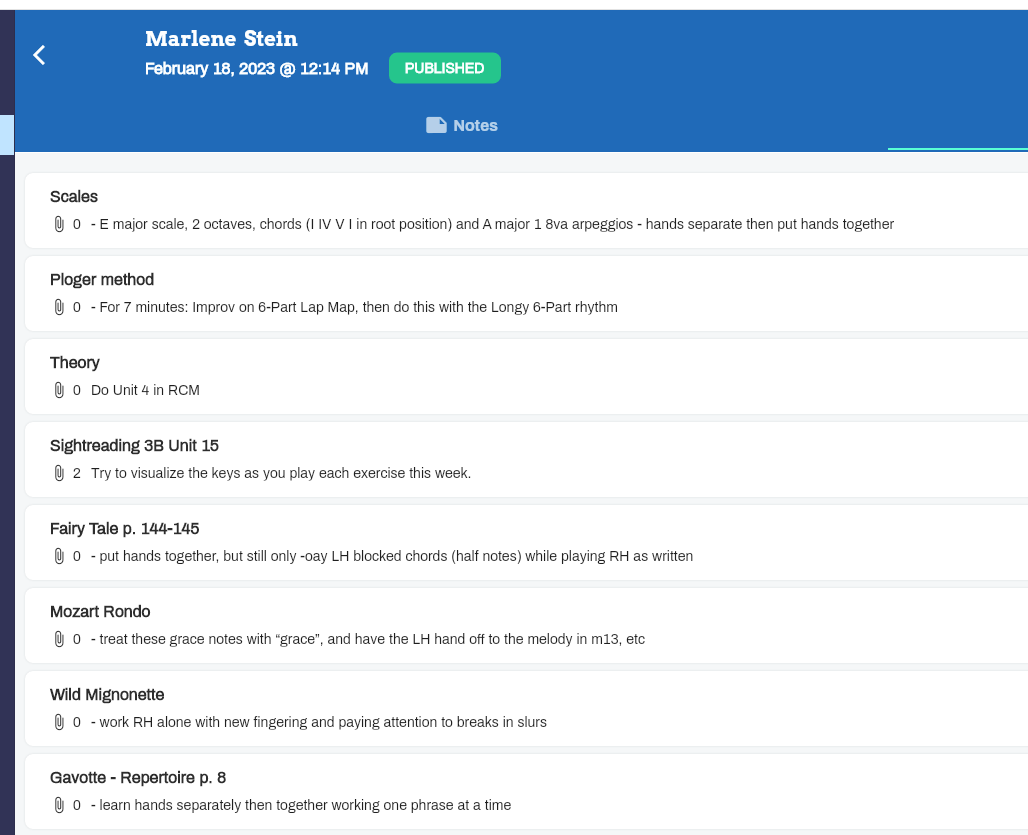
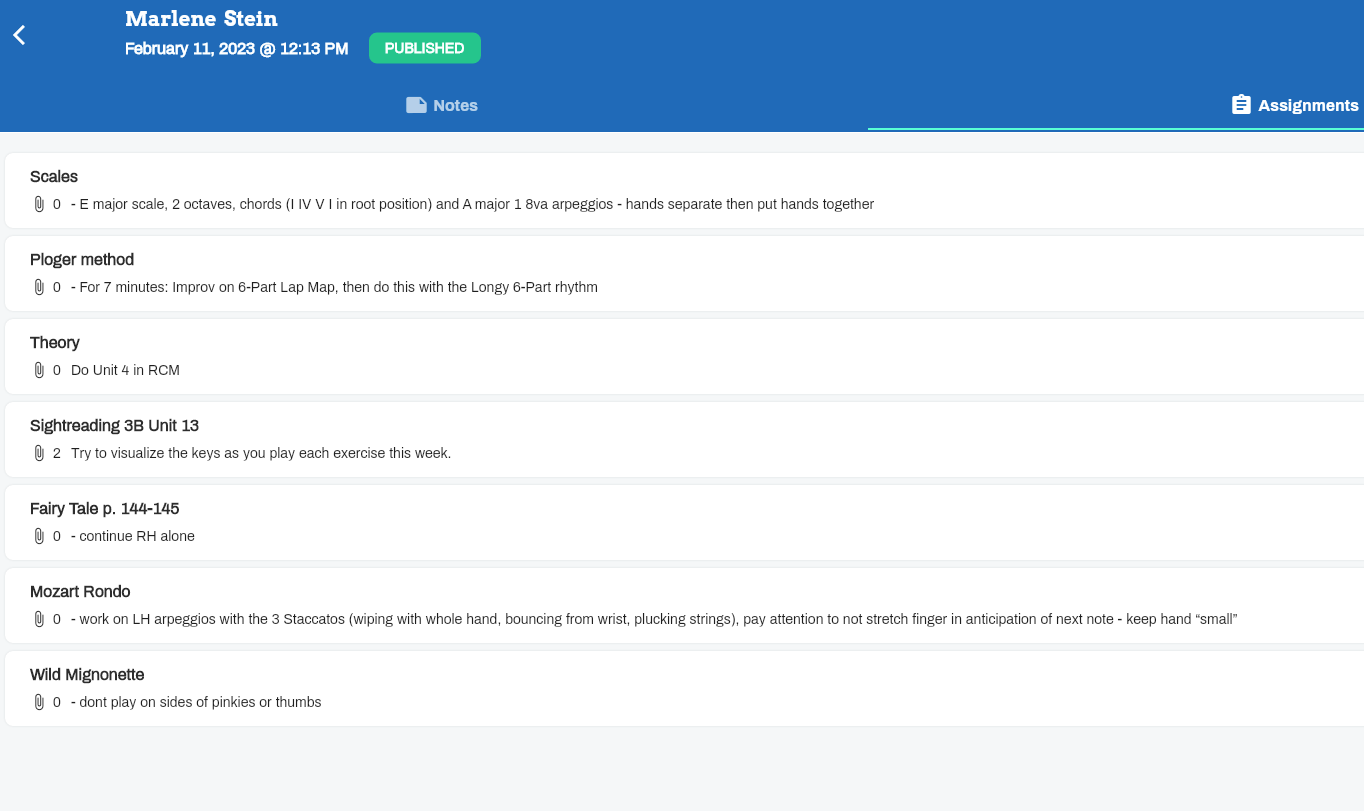
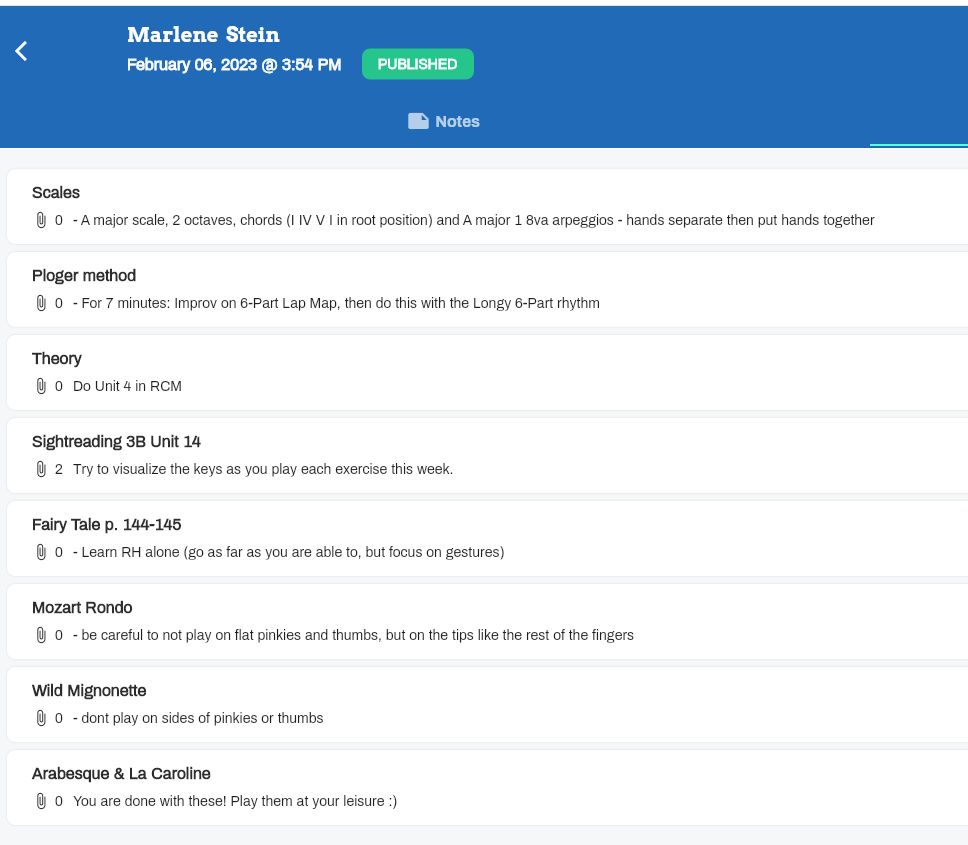

Leave A Comment